


1. Solitaire Mahjong Classic 2 Game Overview
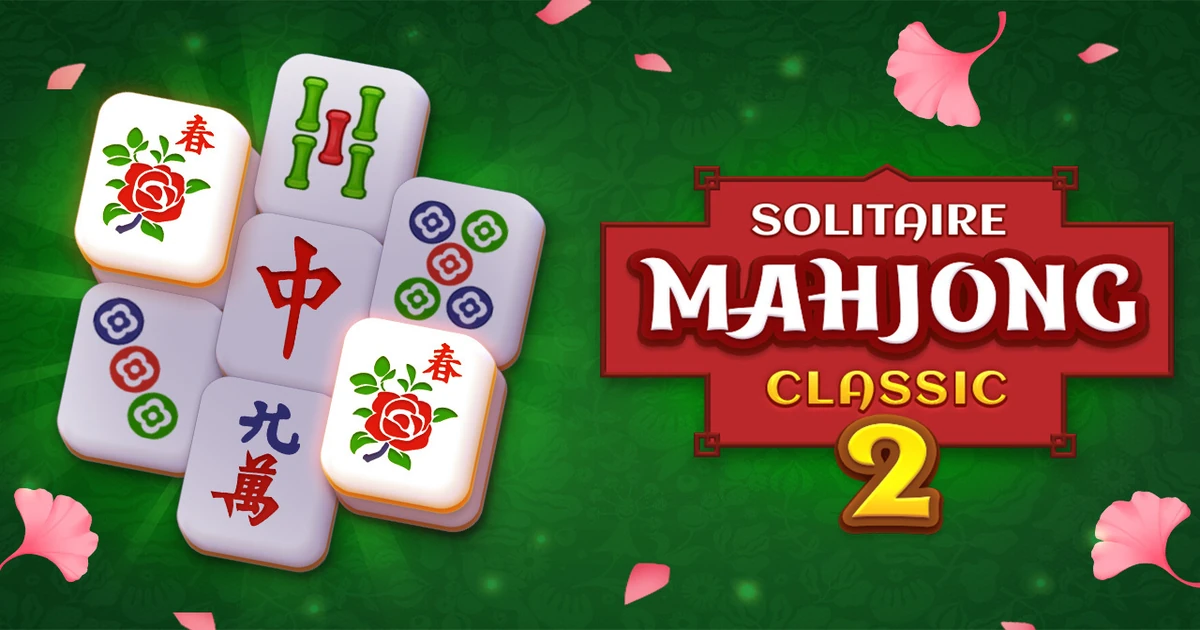
Solitaire Mahjong Classic 2 is the refined continuation of the Solitaire Mahjong series — a classic mahjong tile-matching game that improves on its predecessor with an expanded support system, timed match challenges, and more levels designed to push your tile-connecting skills progressively further.
The core remains the beloved mahjong solitaire formula: identify two identical tiles that are both accessible (free on at least one side, nothing blocking them from above), click them to remove the pair, and continue clearing until the board is empty. The rules are immediately familiar to anyone who has played mahjong, but the depth comes from sequencing — which pairs to clear in which order to keep the board open and avoid isolating tiles with no accessible partners.
Solitaire Mahjong Classic 2's most practical innovation is its four-assist system. Hint illuminates two matching tiles. Torch reveals all currently matchable tiles on the board simultaneously. Undo reverses your last move. Shuffle rearranges all remaining tiles to create new matching possibilities. These four tools together constitute the most complete support system in the series, giving players genuine flexibility to manage difficult configurations without forcing restarts. The timed match format adds urgency — each level has a time limit, and failing to clear within it requires a replay. This pressure separates leisurely matching from actively efficient play.
Key Details:
| Genre: | Puzzle / Mahjong / Tile Matching |
| Difficulty Level: | Easy to Medium |
| Average Play Time: | 5–10 minutes per level |
| Best For: | Mahjong fans who enjoy timed tile-matching challenges with a comprehensive support toolkit |
2. How to Play Solitaire Mahjong Classic 2
Getting Started:
- The board displays mahjong tiles in a classic stacked arrangement.
- Identify two identical tiles that are both accessible — free on at least one lateral side and not covered from above.
- Click both matching accessible tiles to remove them.
- Continue clearing pairs to reduce the board toward empty.
- Complete the full board clearance within the time limit to finish the level.
Basic Controls:
- Click to Select: Click an accessible tile to select it.
- Click to Match: Click an identical accessible tile to remove the pair.
- Hint Button: Highlights one valid matching pair.
- Torch Button: Reveals all currently matchable tiles on the board.
- Undo Button: Reverses your last pair removal.
- Shuffle Button: Rearranges all remaining tiles to create new matching opportunities.
Objective: Clear all tiles from the board by matching accessible identical pairs within the time limit for each level.
3. Solitaire Mahjong Classic 2 Features & Highlights
- ✓ Four-assist toolkit — Hint, Torch, Undo, and Shuffle provide comprehensive support for all difficulty situations
- ✓ Timed match format — each level has its own time limit, adding urgency and rewarding efficient matching
- ✓ Classic mahjong tile set — traditional symbols that create a familiar, authentic mahjong aesthetic
- ✓ Series progression — builds on the first version with new levels and enhanced features
- ✓ Torch assist — a particularly powerful tool that reveals all currently matchable tiles simultaneously
4. Solitaire Mahjong Classic 2 Tips & Strategies
Beginner Tips:
- Use Torch first when stuck, Hint second. Torch reveals ALL currently matchable tiles, giving you the full picture of available options. Hint only shows one pair. Start with Torch when you're uncertain — it provides more information for the same assist cost.
- Remove tiles that unblock the most other tiles. When multiple valid pairs are available, choose the pair whose removal exposes the most previously blocked tiles. Cascade access is more valuable than individual pair convenience.
- Watch the timer from the first move. Each level has its own time limit. Don't fall into the trap of playing casually for the first half of the time and then rushing — maintain efficient matching speed from the first pair.
Advanced Strategies:
- Use Undo for planning, not just correction. Undo reverses a move — which means you can make a test move, evaluate the resulting board state, and undo if it wasn't optimal. Deliberate use of Undo as a planning tool produces better matching sequences than correcting only obvious mistakes.
- Save Shuffle for genuine deadlocks. Shuffle is your most powerful assist — it restarts the accessibility landscape. Use it only when no accessible pairs exist (not just when the current pairs are inconvenient). A Shuffle used on a manageable board wastes a critical resource for a genuine deadlock.
- Identify rare tile types early. Some tile symbols appear only twice in a level's full set — exactly one pair. Locate both tiles of each rare type at the start and protect their accessibility through your clearing sequence.
What to Watch Out For:
- Timer mismanagement. Different levels have different time limits. Check each level's available time before beginning and calibrate your pace accordingly — some limits are generous, some are tight.
- Torch over-reliance. Torch is powerful, but using it as a default first response to every uncertain moment removes the board-reading challenge that makes mahjong rewarding. Use it when genuinely stuck, and try to find pairs independently first.
5. Solitaire Mahjong Classic 2 Game Elements Explained
The Four-Assist System: Solitaire Mahjong Classic 2's most distinctive feature is its comprehensive four-assist toolkit. Hint selectively reveals one valid matching pair — useful for finding a move you've overlooked without overwhelming you with information. Torch reveals all currently accessible matching pairs simultaneously — a broader reveal that shows the full range of available options rather than a single suggestion. Undo reverses the most recent pair removal, restoring the board to its pre-move state — useful both for correcting errors and for exploring alternative move sequences without commitment. Shuffle rearranges all remaining tiles into a new configuration, creating new matching opportunities when the board is genuinely deadlocked with no valid pairs accessible. Together, these four tools address every situation a stuck player might encounter — each is specifically suited to a different problem type.
The Timed Match System: Each level in Solitaire Mahjong Classic 2 has its own time limit that must be met for successful completion. Failed completion within the time limit requires replaying the level. This timing constraint changes the strategic calculus compared to untimed mahjong: deliberate planning that costs significant time must be balanced against maintaining efficient matching speed. Players who pause too long on individual decisions may find themselves time-pressed on the final tiles; players who match too reflexively without planning may isolate important tiles and stall. The optimal approach is measured efficiency — quickly scanning for high-cascade pairs rather than the first available pair, while not spending so much time evaluating that the clock becomes the actual obstacle.
The Series Progression: As the second version in the Solitaire Mahjong series, Classic 2 builds on its predecessor with new features designed to improve and expand the experience. The four-assist system represents an enhancement over earlier version support tools, providing more comprehensive and targeted assistance options. The level design introduces configurations not found in the first version, presenting tile arrangements of increasing complexity and requiring more sophisticated clearing sequences. Players who begin the series with Classic 2 find a complete, fully featured mahjong experience; players who come from the first version discover meaningful additions that justify engaging with the sequel as a distinct experience.
6. Solitaire Mahjong Classic 2 Frequently Asked Questions
Q: What makes a tile "accessible" and matchable?
A: An accessible tile has no other tile resting on top of it AND has at least one open lateral side (no tile immediately adjacent to its left or right). Both conditions must be met simultaneously.
Q: What's the difference between Hint and Torch?
A: Hint reveals one valid matching pair on the board. Torch reveals ALL currently accessible matching pairs simultaneously. Torch provides more information — use it when you want a complete picture of available options rather than a single suggestion.
Q: When should I use Shuffle?
A: Use Shuffle when no accessible matching pairs exist anywhere on the board — when you're genuinely deadlocked, not merely when convenient pairs are scarce. Shuffle is your most powerful assist; saving it for true deadlocks preserves its maximum value.
Q: What happens if I run out of time?
A: The level ends and must be replayed. Each level has its own specific time limit — check the timer as you start and maintain matching efficiency throughout rather than playing casually and rushing at the end.
Q: Can I use assists multiple times in one level?
A: Yes — all four assists are available for use throughout a level. Some versions may limit how many times specific assists can be used; check your version's interface for any usage limits.