


1. Solitaire Chess Game Overview
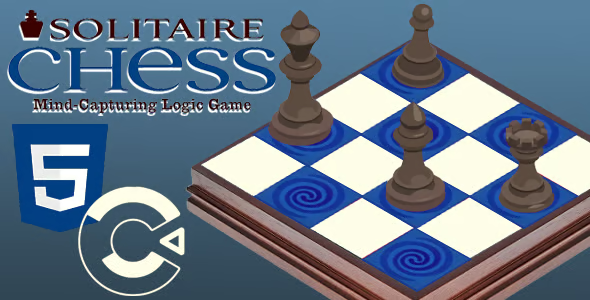
Solitaire Chess is a brilliantly conceived hybrid that asks a simple but fascinating question: what if the goal of a chess game wasn't to checkmate the opponent, but to eliminate every single piece on the board until only one remained? The result is a solo puzzle game where chess piece movement rules provide the mechanics and solitaire-style clearing provides the objective — and the combination produces something genuinely unique.
The premise is immediately compelling for chess players: you know how every piece moves. The King steps one square in any direction. The Knight jumps in an L. The Bishop slides diagonally. The Rook commands ranks and files. In regular chess, these movements serve the purpose of capturing the opponent. In Solitaire Chess, capturing IS the purpose — and the puzzle is figuring out the right sequence of captures to clear the board down to one piece.
The challenge is more nuanced than it first appears. Chess pieces can only capture by moving according to their movement rules, which means some captures are available and some aren't depending on current board position. The order of captures matters enormously: capturing the wrong piece first can isolate other pieces with no available captures, leaving you stuck with multiple pieces and no valid moves. Finding the correct sequence — the one path through the board that chains captures into a complete clear — is the intellectual pleasure the game delivers.
Move highlights make the game accessible even to players without deep chess knowledge: select a piece and every valid move illuminates automatically. You can solve Solitaire Chess by learning piece movement as you play, making it an excellent gentle introduction to chess movement rules alongside its standalone puzzle value.
Key Details:
| Genre: | Puzzle / Chess / Logic |
| Difficulty Level: | Medium to Hard |
| Average Play Time: | 5–15 minutes per puzzle |
| Best For: | Chess players who enjoy solo puzzle challenges; puzzle fans looking for a logic game that teaches chess piece movement |
2. How to Play Solitaire Chess
Getting Started:
- Chess pieces are arranged on a compact board — far fewer pieces than a standard chess game.
- Click a piece to select it — valid moves for that piece are highlighted automatically.
- Move the piece to a highlighted square that contains an opponent piece to capture it.
- The captured piece is removed; continue making capture moves to clear the board.
- Leave exactly one piece on the board to solve the puzzle.
Basic Controls:
- Click to Select: Click a chess piece to see its valid moves highlighted.
- Click Destination: Click a highlighted square containing a piece to move there and capture.
- Hints: Visual move highlights are available to guide piece movement decisions.
Chess Piece Movement Reference:
- King: One square in any direction
- Queen: Any number of squares in any direction
- Rook: Any number of squares horizontally or vertically
- Bishop: Any number of squares diagonally
- Knight: L-shape (2 squares one direction, 1 perpendicular)
- Pawn: One square forward; captures one square diagonally forward
Objective: Capture every piece on the board through valid chess moves, leaving exactly one piece remaining. The puzzle is finding the correct sequence of captures that makes a complete board clear possible.
3. Solitaire Chess Features & Highlights
- ✓ Chess movement + solitaire clearing — a genuinely novel hybrid that uses chess mechanics to power a solo puzzle
- ✓ Visual move highlighting — valid destinations illuminate on piece selection, making the game accessible without chess experience
- ✓ Sequence-dependent challenge — clearing order matters; wrong sequences lead to isolated uncapturable pieces
- ✓ Chess rules as puzzle constraints — each piece type's movement restriction creates different puzzle challenges
- ✓ Compact board size — fewer pieces than standard chess means each puzzle is achievable in minutes
4. Solitaire Chess Tips & Strategies
Beginner Tips:
- Use the move highlights freely. Select every piece you're considering to see all its valid moves before committing to any capture. The highlights reveal which captures are currently possible — information that's essential for planning the full sequence.
- Avoid isolating pieces. Before making a capture, check that the resulting board state still has at least one valid capture available for the remaining pieces. A position where any piece has no valid capture path to the others is unsolvable from that state.
- Think backward from the end. What one piece do you want to be the last one remaining? Work backward — what position does that piece need to be in to make the final capture, and what sequence of moves gets it there?
Advanced Strategies:
- Identify the piece with the most restricted movement. Pawns and Kings have the most limited movement options. Determine early which captures they can make and plan your sequence to use them while their targets are still reachable.
- Look for forced sequences. In many Solitaire Chess puzzles, one piece has only one valid capture at any given moment. These forced moves reveal themselves as you examine the board — start with the forced moves to establish the sequence's skeleton, then fill in the flexible choices.
- Knight movement is the trickiest. Knights jump in L-shapes and can be positioned to capture pieces that seem far away. When a piece looks isolated from everything else, check whether a Knight can reach it — the L-jump often creates connections that straight-line movement can't.
What to Watch Out For:
- Leaving two uncapturable pieces. The most common failure in Solitaire Chess is reaching a two-piece board state where neither piece can capture the other because their movement rules don't create a valid capture path between their positions. This is always caused by an error earlier in the capture sequence.
- Underusing the Queen and Rook. Long-range pieces like the Queen and Rook can reach most squares on the board, making them powerful chain-capture tools. Players who under-utilize them in favor of close-range pieces miss the most efficient routing opportunities.
5. Solitaire Chess Game Elements Explained
The Chess Movement Constraint System: Solitaire Chess's entire puzzle architecture rests on the constraint that pieces can only move according to their standard chess movement rules. A Rook can only move horizontally or vertically; a Bishop only diagonally; a Knight only in its L-shape jump. These constraints are what transform a simple "capture everything" objective into a genuine puzzle — certain pieces can only reach certain other pieces from certain positions, which means the capture sequence isn't arbitrary. Finding the valid sequence requires understanding which piece can capture which other piece from its current position, what position it will be in after that capture, and whether that position then allows the next required capture. This chain-logic creates puzzles that are solvable through careful analysis rather than brute-force trial-and-error.
The Visual Move Highlight System: To make Solitaire Chess accessible without requiring deep chess knowledge, the game provides an automatic move highlighting system. When you click any piece, every square that piece can legally move to illuminates immediately. If an illuminated square contains another piece, clicking it executes a capture. This system removes the cognitive burden of memorizing movement rules — you can click pieces to explore their options and learn the movement patterns through observation. For experienced chess players, the highlights confirm what they already know. For newcomers to chess piece movement, the highlights serve as a real-time tutorial that teaches movement rules through puzzle-solving context rather than abstract instruction.
The Sequence Dependency System: Unlike puzzles where individual moves are evaluated independently, Solitaire Chess is entirely sequence-dependent — the order of captures determines whether the board is clearable. A board that looks solvable from the starting position might become unsolvable after two suboptimal captures, even though each of those captures was individually valid. This sequence dependency is the game's primary depth layer: surface-level play involves finding any valid capture; skilled play involves finding the valid capture sequence that chains to a complete board clear. The hint system helps reveal which pieces are currently stuck (no valid captures available to them), but identifying the correct full sequence from the start is the puzzle's genuine intellectual challenge.
6. Solitaire Chess Frequently Asked Questions
Q: Do I need to know how to play chess to enjoy Solitaire Chess?
A: No — the move highlight system shows you every valid move for any piece you select, so you can learn piece movements through the game itself. Basic chess movement knowledge is helpful but not required.
Q: What happens if I can't clear all the pieces?
A: If you've made captures that have left pieces with no valid capture routes to each other, the puzzle is stuck from that state. Use the undo function to reverse your last few captures and try a different sequence.
Q: Why am I left with two pieces at the end that can't capture each other?
A: This happens when the capture sequence was wrong at some earlier point — the two remaining pieces don't have valid movement paths to each other's positions. Restart the puzzle and look for a different capture ordering that routes the final two pieces into a capturable configuration.
Q: Is there an undo function?
A: Check the game interface for an undo button — most Solitaire Chess implementations include one. Undo lets you reverse captures to try a different sequence without restarting the full puzzle.
Q: How many pieces are in a Solitaire Chess puzzle?
A: The puzzles use a small subset of pieces compared to a full chess game — typically between 4 and 10 pieces on a compact board. This makes each puzzle completable in minutes while still providing genuine sequence-planning challenge.