


1. Golf Solitaire Game Overview
Golf Solitaire is a streamlined, deeply satisfying card game that marries the sequential logic of solitaire with the elegant scoring sensibility of golf. The fewer moves you need, the better — and unlike games where more activity always feels like more progress, Golf Solitaire rewards economy, planning, and the patience to find the longest possible clearing sequence before touching anything.
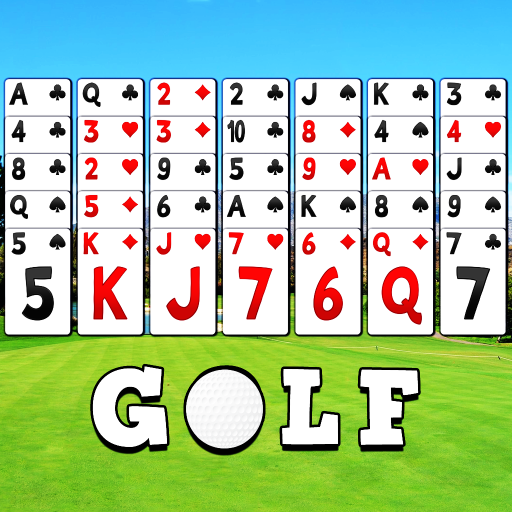
The goal is clean: clear every tableau card by building a continuous sequence in the waste pile, one rank higher or lower at each step, alternating up and down freely as the available cards dictate. A sequence might climb from 5 to 6 to 7, then reverse back down through 6 to 5 to 4 to 3, then climb again — following whatever the tableau offers rather than any fixed direction. The flow is natural and satisfying when it works, and the puzzle is finding how to make it work across the entire tableau layout.
When the tableau offers no valid next card, you flip from the stockpile — which is the game's equivalent of taking an extra golf stroke. The stockpile is finite, so every flip spent on a dead end is a flip that won't be available later when you might need it more. That resource tension — combined with the undo button that lets you reverse decisions and try alternatives — makes Golf Solitaire genuinely more strategic than it first appears.
No time limit means the game rewards careful thought over reflexive play. Sit with a layout, trace your sequences, identify the longest viable chain, and then execute it with the confidence of a planned approach.
Key Details:
| Genre: | Card Game / Solitaire |
| Difficulty Level: | Easy to Medium |
| Average Play Time: | 10–20 minutes per game |
| Best For: | Solitaire fans who enjoy sequence-building, resource management, and relaxed strategic card games with no time pressure |
2. How to Play Golf Solitaire
Getting Started:
- Cards are dealt face-up across the tableau — all visible and available to plan from.
- A starting card is placed in the waste pile as your initial base.
- Click any tableau card that is one rank higher or lower than the current waste pile top card.
- That card becomes the new waste pile top — continue building the sequence from it.
- When no valid tableau card exists, flip the top stockpile card to create a new base, then continue.
Basic Controls:
- Mouse Click: Click a valid tableau card to move it to the waste pile.
- Click Stockpile: Flip the next stockpile card to continue when no tableau card is available.
- Undo Button: Reverse your previous move to try a different approach.
- Fullscreen Option: Available for a larger, more comfortable playing experience.
Objective: Clear all tableau cards to the waste pile by building a continuous ascending/descending sequence (one rank higher or lower each step, any suit). Use the stockpile to continue when stuck, and the undo button to reverse suboptimal moves.
3. Golf Solitaire Features & Highlights
- ✓ Free bi-directional sequencing — chains can ascend and descend freely, following the tableau's natural flow
- ✓ No time limit — completely pressure-free play that rewards deliberate, careful planning over speed
- ✓ Undo button — reverse any move without penalty to explore different sequence paths
- ✓ Fullscreen support — play in fullscreen for a cleaner, more immersive card game experience
- ✓ Clean 2D presentation — clear graphics and soft background music create a relaxed playing atmosphere
4. Golf Solitaire Tips & Strategies
Beginner Tips:
- Scan the entire tableau before your first click. All cards are visible from the start — use that advantage. Trace several possible sequence paths before committing to the first available card. The most immediately available move is rarely the most efficient one.
- Aim for the longest chain you can identify, not the nearest valid card. A 2-card sequence that ends at a dead end is worse than a 7-card sequence that requires one extra step to start. Always ask "what does this card open up?" before clicking it.
- Save stockpile flips for genuine dead ends. The stockpile is a finite resource. Don't flip when a tableau card will do — even if the tableau card isn't the most convenient option. Every flip preserved is flexibility saved for later.
Advanced Strategies:
- Use undo to test-drive sequence branches. Golf Solitaire's undo button is a legitimate strategic tool, not just an error correction. Play a few cards down one sequence path, see where it leads, undo if it's suboptimal, and try an alternative branch. Iterative path-testing produces significantly better outcomes than committing to the first plausible sequence.
- Identify your Aces and Kings early. Aces connect only to 2s; Kings connect only to Queens (unless Ace-King wrapping is enabled in your version). These extreme-rank cards can strand entire sections of the tableau. Locate them at the start and plan your sequence to stay accessible to their only valid neighbors.
- Build toward pivot values. The most valuable tableau cards are mid-range values (5s, 6s, 7s, 8s) that can connect ascending and descending sequences. Routing your chain through these pivot cards keeps the sequence alive through multiple direction changes.
What to Watch Out For:
- Isolating a card by clearing everything around it. If you clear all cards adjacent to a specific tableau card without having cleared that card itself, you may remove your access to a valid sequencing path that ran through it. Always think about accessibility, not just the immediate sequence value.
- Burning through the stockpile too early. Players who flip frequently in the first half of the game often run out of stockpile before the tableau is clear. If you've already flipped five times and the tableau is less than half cleared, start looking harder for tableau chains before flipping again.
5. Golf Solitaire Game Elements Explained
The Bi-Directional Sequence System: Golf Solitaire's defining mechanic is its freely ascending and descending sequence building. Unlike solitaire variants with fixed directional rules, here each card you add to the waste pile only needs to be one rank away from the current top — either one higher or one lower. A sequence of 6-7-8-7-6-5-6-7-8-9 is entirely valid. This freedom allows sequences to flow naturally through the tableau's card distribution rather than being constrained to a fixed direction. The bi-directional flexibility makes longer sequences achievable than in fixed-direction variants — but it also makes the planning challenge richer, since you have more options to evaluate at each step and the "best path" is less obvious. Reading multi-step sequences that weave up and down through the tableau is the game's primary cognitive skill.
The Stockpile Resource System: When no valid sequence card exists in the tableau, you flip the top card of the stockpile to create a new waste pile base and potentially restart your chain. The stockpile has a limited number of cards — once it's exhausted, you can no longer continue if the tableau still has cards. This finite nature makes the stockpile a resource to be managed carefully rather than a free rescue mechanism. Each flip is a strategic expenditure: worth making when the tableau is genuinely stuck, but potentially wasteful if a tableau chain exists that you haven't spotted yet. Players who develop strong sequence-reading skills use the stockpile sparingly, spending it only on true dead ends and completing most of the tableau through long, uninterrupted chains.
The Undo System: The undo button in Golf Solitaire allows you to reverse your most recent card move without penalty. This might seem like a simple error-correction tool, but experienced players use it as a deliberate planning mechanism. Making a move and observing its consequences — which card it makes the new waste pile top, which tableau cards that exposes as next options — provides concrete information that's sometimes clearer after the move than before it. If the revealed consequence is suboptimal, undoing and taking an alternative route gives you that information for free. The willingness to undo speculatively (rather than only correctively) is one of the most impactful technique improvements available in Golf Solitaire.
6. Golf Solitaire Frequently Asked Questions
Q: What determines which tableau cards I can move to the waste pile?
A: Any face-up tableau card that is exactly one rank higher or one rank lower than the current top card of the waste pile is valid. Suit doesn't matter — only rank proximity. A 7 allows any 6 or 8; a King allows any Queen; an Ace allows any 2.
Q: Is there a time limit?
A: No — Golf Solitaire has no time limit. Take as long as you need to plan your sequences. The only performance measure is how efficiently you clear the tableau, not how fast you do it.
Q: What happens when both the tableau and stockpile are exhausted before clearing all cards?
A: If all stockpile cards have been flipped and no valid tableau move remains, the game ends without a full clear. Restarting and focusing on longer chain sequences — to use fewer stockpile flips per clear — will produce better outcomes.
Q: Can sequences wrap around from King to Ace or Ace to King?
A: This depends on the specific version of Golf Solitaire you're playing. Some versions allow Ace-King wrapping (treating Ace as both rank 1 and rank 14), which creates additional sequencing flexibility. Check the game's rules indicator or test it in play.
Q: How do I use the undo button effectively?
A: Click the undo button immediately after a move to reverse it if you spot a better alternative. Don't limit undo to error correction — use it proactively to test whether a different sequence path from the same starting point produces a longer chain or better waste pile position.