








1. Jungle Mahjong Game Overview
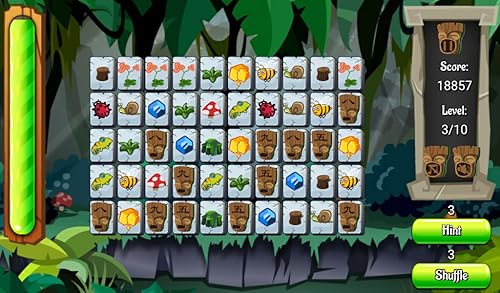
Jungle Mahjong transports the classic tile-matching formula into a lush, immersive jungle setting where every level is a verdant puzzle waiting to be cleared. The tiles — adorned with jungle-themed imagery — sit in layered formations across the board, and your task is to identify and remove matching pairs until the board is completely empty and the jungle is cleared.
The game's accessibility is one of its genuine strengths. The objective couldn't be clearer — click matching tiles, clear the board, advance through levels — but the strategic depth that emerges from the accessibility rules keeps the experience engaging well past the initial introduction. Only tiles that are "open" from the left or right side can be selected, which means half the puzzle is always about sequencing: not just finding matching tiles, but finding matching tiles that are both currently accessible and that, when removed, open the most valuable new matching opportunities beneath them.
The jungle visual theme does real work here. Lush greens, vivid tile artwork, and an immersive atmosphere make Jungle Mahjong genuinely pleasant to spend time in — which matters in a game where longer, more complex puzzles can keep you engaged for extended periods. The aesthetic isn't window dressing; it creates a sense of place that makes each level feel like an exploration rather than just a puzzle to solve.
Level progression introduces increasing complexity, with each stage presenting a new board formation that demands fresh strategic reading. Memory and concentration build naturally across the level sequence, and the satisfaction of clearing a densely stacked jungle formation is a consistent reward throughout.
Key Details:
| Genre: | Puzzle / Mahjong / Tile Matching |
| Difficulty Level: | Easy to Medium |
| Average Play Time: | 5–10 minutes per level |
| Best For: | Casual puzzle fans who enjoy tile-matching games with accessible rules, strategic depth, and visually appealing themed environments |
2. How to Play Jungle Mahjong
Getting Started:
- Survey the board — tiles are arranged in layered formations with some accessible and others blocked.
- Identify two tiles showing the same image that are both open from either their left or right side.
- Click both matching open tiles to remove them from the board.
- Continue clearing pairs, progressively exposing buried tiles beneath removed ones.
- Clear all tiles from the board to complete the level and advance.
Basic Controls:
- Click / Tap to Select: Click or tap an open tile to select it.
- Click / Tap to Match: Click or tap a second open tile showing the same image to remove the pair.
Objective: Clear every tile from the board by matching and removing all identical open tile pairs. Complete all levels to emerge victorious in Jungle Mahjong's full tile-matching adventure.
3. Jungle Mahjong Features & Highlights
- ✓ Jungle-themed tile artwork — lush, immersive jungle imagery that creates a distinct visual atmosphere
- ✓ Left/right accessibility rule — a specific constraint that adds meaningful strategic depth beyond simple symbol matching
- ✓ Progressive level structure — each new level presents a unique board formation with increasing complexity
- ✓ Memory and concentration development — consistent play builds tile recognition and strategic planning skills
- ✓ Visually immersive experience — the jungle setting makes extended puzzle sessions feel engaging rather than repetitive
4. Jungle Mahjong Tips & Strategies
Beginner Tips:
- Check both sides of every tile before clicking. A tile is open only if it has free space on its left or right side. Tiles blocked on both sides cannot be selected, even if they show a matching symbol. Confirm accessibility before attempting any selection.
- Remove pairs that expose the most new tiles. Not all pairs are equally valuable to remove. A pair buried in a dense cluster that exposes four new tiles when removed is more strategically valuable than an edge pair that exposes nothing. Prioritize impact over convenience.
- Look for rare tile symbols early. Some symbols appear only once as a pair in the entire board. Locate both tiles of each rare pair at the start of the level — ensuring one isn't inadvertently blocked while the other remains open is critical to avoiding unresolvable situations.
Advanced Strategies:
- Trace cascade chains before your first click. The best levels are solved by identifying multi-step clearing sequences before any tiles are removed. A pair that, when cleared, exposes another pair, which exposes another, creates a cascade chain that rapidly clears large sections of the board with minimal scanning interruption.
- Balance clearing between board sections. Working exclusively on one section of the board while another remains untouched creates accessibility imbalances — one section may become fully open while the other is still densely blocked. Alternate your clearing attention across the full board to maintain even accessibility development.
- In later levels, read the "shape" of the formation first. Jungle Mahjong's later levels use progressively more complex tile formations. Spending 10–15 seconds reading the formation's structure — identifying which tiles are at the apex of the stack and which are deep inside — produces better early clearing decisions than immediately clicking the first accessible pair you see.
What to Watch Out For:
- Accessibility creep. Over multiple clearing moves, a section of the board can gradually become fully blocked — all accessible tiles removed, all remaining tiles inaccessible — due to earlier clearing choices. Scan the full board periodically to ensure all sections still have accessible tiles available.
- Rushing to obvious pairs. Obvious matches (two accessible identical tiles near the board's edges) are tempting to clear immediately. But obvious pairs may be the only accessible path to a deeper, more important pair — clearing them may be right, or it may lock you out of something more critical. Evaluate before clicking.
5. Jungle Mahjong Game Elements Explained
The Left/Right Accessibility System: Jungle Mahjong's defining accessibility rule differs from some mahjong variants in its specificity: a tile is open and selectable only when it has free space on either its left or right side — not just when it has no tile on top. This means a tile that's fully uncovered from above but hemmed in on both sides by adjacent tiles is still inaccessible. The left/right rule creates a more nuanced accessibility landscape than pure stacking rules: tiles can be blocked horizontally even when vertically exposed, requiring players to think about lateral access paths as much as vertical layer removal. This constraint is what gives Jungle Mahjong its strategic depth — the board's accessibility is a function of both what's above and what's beside each tile, creating a two-dimensional accessibility puzzle layered beneath the visual matching task.
The Progressive Level Structure: Jungle Mahjong's levels advance in complexity through progressively challenging board formations rather than through rule changes. The tile symbols, accessibility rules, and matching mechanics remain constant — but the arrangement of those tiles across each new level creates distinct structural challenges. Early levels use relatively flat formations with many initially accessible tiles. Later levels use tall, layered pyramids, interlocking formations, and irregular arrangements that restrict initial accessibility and require more careful sequencing to clear efficiently. This progression model means players who understand the core mechanics from level 1 can engage with the full game immediately, while the escalating formation complexity provides sustained challenge that grows with player skill.
The Memory and Concentration Development System: Jungle Mahjong's promotional framing of the game as a "memory and concentration" trainer reflects a genuine mechanical property. Tracking which tiles are accessible, which pairs have already been identified, and which remaining tiles belong to pairs whose partners are currently blocked requires active working memory throughout each level. Players who've completed multiple levels develop stronger tile-symbol familiarity (faster identification of matching pairs at a glance) and better accessibility-pattern reading (faster evaluation of which tiles to clear first for maximum cascade value). These cognitive skills improve demonstrably with consistent play, making Jungle Mahjong a game that genuinely gets more rewarding over time as your underlying recognition capabilities improve.
6. Jungle Mahjong Frequently Asked Questions
Q: What makes a tile "open" in Jungle Mahjong?
A: A tile is open and selectable when it has free space on either its left or right side — no tile immediately adjacent blocking it laterally. A tile may be uncovered from above (no tile on top of it) but still blocked if tiles are adjacent on both sides. Both conditions — no tile on top AND at least one open lateral side — must be met.
Q: Can I match tiles that are on different layers of the stack?
A: Yes — as long as both tiles are accessible (open on at least one side and not covered from above), they can be matched regardless of which layer of the board formation they're in. The matching requirement is symbol identity and mutual accessibility, not positional proximity.
Q: What happens if I get stuck with no available pairs?
A: If no accessible pairs remain on the board, the level cannot be completed from the current state. Restart the level and focus on choosing clearing sequences that maintain accessibility across the full board rather than over-clearing one section while leaving another blocked.
Q: Is there a time limit in Jungle Mahjong?
A: The base game is untimed, allowing deliberate planning at your own pace. Some versions may include optional timed modes — check your specific version for time-based challenge availability.
Q: How many levels does Jungle Mahjong include?
A: Jungle Mahjong features a progressive level sequence with increasing formation complexity. The full level count varies by version — check the level selector for the complete available roster in your specific implementation.