





1. Merge Fruit Game Overview
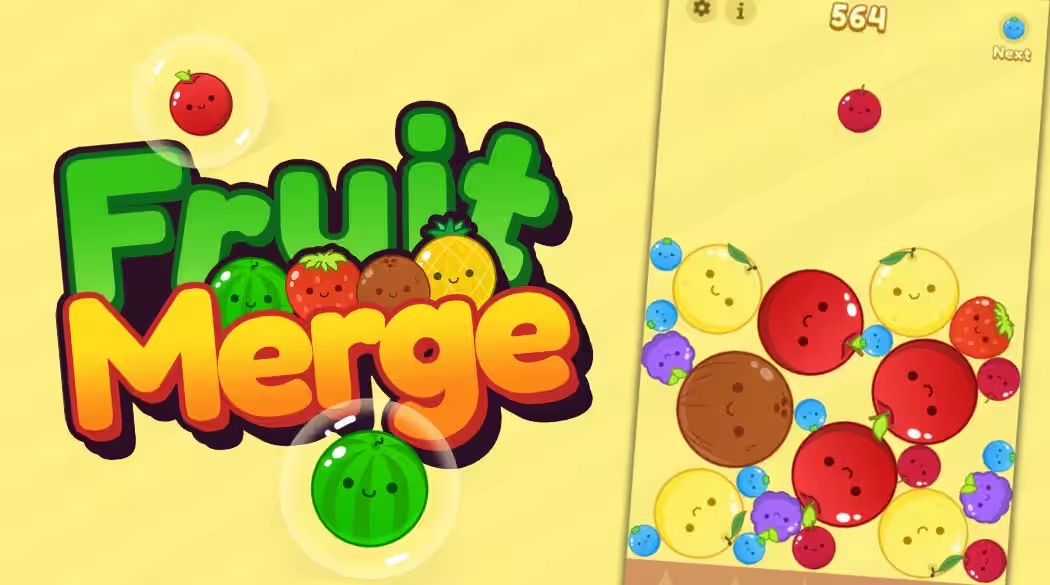
Merge Fruit is a wonderfully satisfying puzzle game that combines the physics-drop mechanic of dropping fruit into a container with the merging logic of 2048-style number doubling — except here, your fruits get bigger, juicier, and more colorful with every successful merge. Drop a cherry next to another cherry and they fuse into a bigger fruit. Keep merging and your container evolves from a scattering of tiny cherries into magnificent, space-filling melons — all the way up to the legendary Golden Watermelon.
The dropping mechanic is the game's first pleasure. You have control over where each fruit falls, which sounds simple until you realize that every previous fruit is still there, stacked in ways that influence what's accessible for the next merge. Positioning matters enormously — a well-placed fruit can cascade into two or three merges simultaneously; a poorly placed one creates an unproductive gap that resists further merging and wastes valuable vertical space.
The game's constant threat is the creeping boundary line. As your fruit pile grows, it approaches the upper limit — and if any fruit crosses that line, the game ends. This creates the same elegant tension that makes 2048 compelling: every merge clears space, but it also displaces existing fruit in ways that may help or hurt your overall stack management. Building toward the Golden Watermelon is the aspirational goal; surviving long enough to get there is the real challenge.
With physics that feel satisfying, merges that deliver genuine visual payoff, and a difficulty curve that starts forgiving and grows genuinely demanding, Merge Fruit is an endlessly replayable casual puzzle that's hard to put down.
Key Details:
| Genre: | Puzzle / Physics / Merge |
| Difficulty Level: | Easy to Hard (escalates with fruit value) |
| Average Play Time: | 5–20 minutes per session |
| Best For: | Casual puzzle players who enjoy merge mechanics, physics-drop games, and satisfying visual progression toward escalating fruit goals |
2. How to Play Merge Fruit
Getting Started:
- A fruit appears at the top of the container — choose where to drop it by moving your cursor left or right.
- Release to drop the fruit, which falls and lands on the existing stack (or the container floor).
- When two identical fruits touch, they merge into the next-larger fruit type.
- Keep merging to evolve your fruit up the chain: cherry → strawberry → grape → and so on toward the Golden Watermelon.
- Avoid letting the fruit pile grow high enough to cross the boundary line — if any fruit touches the line, the game ends.
Basic Controls:
- Mouse Left/Right (PC): Move the cursor to position where the next fruit will drop.
- Click / Release: Drop the fruit from the current position.
- Touch & Drag (Mobile): Drag left or right to position, release to drop.
Objective: Merge fruits progressively to create larger, higher-value fruits — ultimately working toward the Golden Watermelon. Manage the fruit stack to prevent it from crossing the upper boundary line while maximizing your score through successful merges.
3. Merge Fruit Features & Highlights
- ✓ Physics-based fruit dropping — each fruit falls with realistic physics that affect how the stack builds and where merges occur
- ✓ Escalating fruit merge chain — a satisfying visual and gameplay progression from tiny cherries to massive watermelons
- ✓ Boundary line tension — the creeping height limit creates constant pressure that escalates as your stack grows
- ✓ Wall bounce positioning — fruits can be bounced off container walls for precise placement in tight spaces
- ✓ Golden Watermelon ultimate goal — a clear, satisfying long-term objective that anchors the full session strategy
4. Merge Fruit Tips & Strategies
Beginner Tips:
- Plan a few drops ahead, not just the current one. Before dropping any fruit, think about what position will be most useful for the two drops after it. Positioning for the current merge is good; positioning for a chain of three consecutive merges is significantly better.
- Drop fruit near existing same-type fruit. The merge happens when identical fruits touch — dropping a strawberry directly on top of another strawberry triggers the merge immediately. Dropping it on the opposite side of the container wastes the match potential until something shifts them together.
- Keep your highest-value fruits near the bottom. Larger fruits are heavier and harder to position — they also take up the most space. Keeping the big merges low creates more headroom above them for incoming smaller fruit.
Advanced Strategies:
- Use wall bounces for precise positioning. The container's side walls are tools, not just boundaries. Angling a drop so the fruit bounces off a wall can land it in a position that a straight drop couldn't reach — particularly useful for reaching a same-type fruit in a narrow gap between other fruit.
- Focus on high-level merges over quantity. Merging two medium-level fruits into one large fruit clears significantly more space and scores more points than merging many low-level fruits. When you have the choice between pursuing a high-value merge or several low-value merges, take the high-value merge.
- Keep a mental path to the Golden Watermelon. The full merge chain is fixed — you always need to work through the same sequence. Knowing which fruit is your current highest and what you need to merge into next prevents you from losing track of your strategic goal during frantic mid-game moments.
What to Watch Out For:
- Isolated large fruit. A high-value fruit stranded in a corner with no matching partner approaching is occupying prime stack space without contributing to your path to the Golden Watermelon. Avoid placing large fruit where they can't be merged soon.
- Stack imbalance. A pile that's significantly higher on one side than the other creates an imminent boundary-crossing risk on the tall side. Deliberately drop fruits on the lower side to rebalance the stack height before it becomes a crisis.
5. Merge Fruit Game Elements Explained
The Physics Drop System: Each fruit in Merge Fruit falls with realistic physics — it drops vertically, bounces off surfaces, and comes to rest based on the shape of the existing stack below it. This physics model is what separates Merge Fruit from grid-based merge games: the landing position isn't predetermined, it's influenced by the shape of everything the falling fruit encounters on the way down. A fruit dropped onto a curved surface will roll to one side; one dropped into a gap will settle deeper than expected; one dropped near a wall might bounce in a useful direction. Reading the current stack's shape and anticipating how a new fruit will interact with it physically — rather than just which cell it occupies — is the spatial skill that Merge Fruit uniquely develops.
The Fruit Evolution Chain: Merge Fruit's progression follows a fixed evolution sequence: identical fruits that touch merge into the next-tier fruit, which in turn can merge with another of its kind to produce the tier above. The chain moves from the smallest, most common fruits (cherries) through intermediate tiers (strawberries, grapes, oranges, and others) up to the largest and rarest (watermelons, with the Golden Watermelon as the ultimate achievement). Each step in the chain represents both a visual upgrade and a meaningful space consolidation — two small fruits become one medium fruit, freeing one unit of space while advancing toward higher merges. The satisfaction of watching the fruit evolution chain progress — visually and tactically — is the game's core emotional reward.
The Boundary Line and Stack Management System: The game's central tension comes from a visible boundary line near the top of the container. If any fruit reaches or crosses this line, the game ends immediately. As you merge and stack, the pile grows upward — initially far below the line, then increasingly close as higher-tier fruit accumulates. Managing the stack's height is as important as maximizing merges: a pile that contains many high-value merges but reaches the boundary line too quickly ends the game before those merges can be executed. The best sessions are ones where stack height is controlled through deliberate positioning — keeping the pile compact, balanced, and low-profile while still building toward high-value merges that score well and consolidate space.
6. Merge Fruit Frequently Asked Questions
Q: How do I merge two fruits?
A: Drop a fruit so it touches another fruit of the same type. When identical fruits make contact, they automatically merge into the next-tier fruit. The merge can happen immediately on landing or after the fruit settles into position.
Q: What is the Golden Watermelon and how do I get it?
A: The Golden Watermelon is the highest-tier fruit in the merge chain — the ultimate achievement in a Merge Fruit session. It's created by merging two regular watermelons. Reaching it requires progressing through the entire fruit evolution chain from the smallest fruit upward, which demands sustained high-level merging throughout a session.
Q: What happens if fruit crosses the boundary line?
A: The game ends immediately when any fruit crosses the upper boundary line. Every positioning decision should account for how it affects your stack's overall height — not just the immediate merge value.
Q: Can I bounce fruits off the container walls?
A: Yes — the side walls are solid surfaces that fruit can bounce off at angles. This is a useful technique for positioning fruit in gaps that a direct vertical drop couldn't reach.
Q: Is there a way to see what fruit is coming next?
A: Some versions display the upcoming fruit (the next one after your current drop) so you can plan two steps ahead. Check your version's interface for a "next fruit" indicator above or beside the drop area.