

1. Klondike Solitaire Game Overview
Klondike Solitaire is the card game — the version of solitaire that defined the genre for most of the world and remains the most recognized single-player card game in existence. Seven tableau columns, four foundation piles, a stockpile, and 52 cards: the simplicity of the setup belies the genuine strategic depth that emerges from each new deal.
The objective is clean: sort all 52 cards onto four foundation piles, one per suit, each ascending from Ace to King. Getting there requires careful tableau management — moving cards between columns in descending order with alternating colors to uncover face-down cards, then sequencing exposed cards toward their foundations. The stockpile provides additional cards when the tableau offers no valid moves, though it's a finite resource that requires disciplined use.
Klondike's enduring appeal comes from a few interlocking qualities. It's immediately learnable — the rules fit in two sentences — but never trivially solved. The alternating-color tableau rule (a design choice unique to Klondike compared to same-color variants like Spider Solitaire) creates distinctive cross-suit dependencies that require thinking across the whole tableau simultaneously rather than focusing on one suit's sequence at a time. The partial information — some cards start face-down — keeps every game partly unpredictable, while the visible cards always give you enough to plan several moves ahead.
This implementation presents all the game's fundamentals cleanly, making it equally suitable as a first solitaire experience and as a reliable daily practice for experienced players.
Key Details:
| Genre: | Card Game / Solitaire |
| Difficulty Level: | Easy to Medium |
| Average Play Time: | 10–20 minutes per game |
| Best For: | Solitaire players of all experience levels; an ideal daily card game for relaxed strategic play |
2. How to Play Klondike Solitaire
Getting Started:
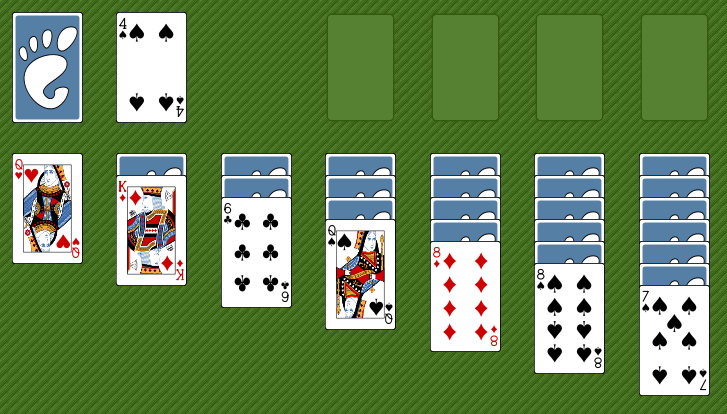
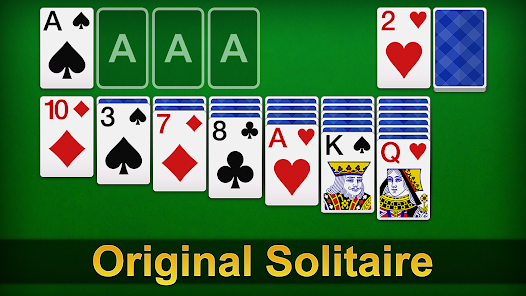
- Cards are dealt into 7 tableau columns — column 1 has 1 card face-up, column 7 has 7 cards with 6 face-down and 1 face-up.
- Move face-up tableau cards onto other face-up tableau cards that are one rank higher and opposite in color.
- When a face-up card is moved, any face-down card beneath it flips face-up and becomes available.
- Move eligible cards to the four foundation piles — starting with Aces, building each suit from Ace up through King.
- Draw from the stockpile when no valid tableau moves exist.
Basic Controls:
- Click to Select: Click a face-up card to select it.
- Click Destination: Click a valid tableau position or foundation pile to move the selected card.
- Click Stockpile: Draw from the stockpile when the tableau offers no valid plays.
- Double-Click: Automatically moves an eligible card to its foundation pile.
Objective: Build all four foundation piles from Ace to King in suit by organizing the tableau in descending rank, alternating-color sequences. Complete all four foundations to win.
3. Klondike Solitaire Features & Highlights
- ✓ Classic Klondike rules — the world's most recognized solitaire format, faithfully implemented
- ✓ Alternating-color tableau system — Klondike's signature rule that creates cross-suit strategic dependencies
- ✓ Seven-column deal — the iconic pyramid-style deal that defines Klondike's visual identity
- ✓ Stockpile access — additional cards available when tableau play is exhausted
- ✓ Face-down card revelation — hidden cards beneath face-up cards create a satisfying information-reveal mechanic
4. Klondike Solitaire Tips & Strategies
Beginner Tips:
- Prioritize uncovering face-down cards. Every face-down card in the tableau is hidden potential. Any move that reveals a face-down card is almost always worth making — more revealed cards mean more available plays.
- Move Aces and Twos to foundations immediately. There's never a strategic reason to keep these in the tableau. Ace and Two placement on foundations is always correct when available.
- Don't empty columns without a King ready. Empty tableau columns can only receive Kings. Clearing a column without an immediate King to fill it wastes a valuable flexible space.
Advanced Strategies:
- Think in sequences, not individual cards. Klondike's tableau moves often involve entire stacks moving together. When evaluating a move, think about the sequence you're moving and whether its destination sets up the next two or three moves advantageously.
- Balance stockpile use with tableau development. Drawing from the stockpile is tempting when the tableau feels stuck, but exhausting the stockpile too quickly removes flexibility later. Exhaust reasonable tableau options before each draw.
- Match colors across columns, not just within them. The alternating-color rule creates cross-column dependencies — the red 9 needs a black 10 somewhere, regardless of which column. Scan the full tableau for useful placements rather than focusing only on your current column.
What to Watch Out For:
- Orphaned high cards. A King placed in an empty column with no Queen of the opposite color available to build on it creates a dead end — that column is blocked until the right Queen appears. Evaluate whether a King placement immediately opens useful building options before committing to it.
- Over-stacking a single column. Building a long sequence in one column while other columns remain face-down and inaccessible is usually suboptimal. Spread your moves across columns to maximize simultaneous face-down card revelation.
5. Klondike Solitaire Game Elements Explained
The Alternating-Color Tableau Rule: Klondike's most distinctive design decision is that tableau sequences must alternate colors (red-black-red-black) in addition to descending in rank. This rule creates cross-suit dependencies that don't exist in same-color variants like Spider Solitaire: a red 9 can only go on a black 10, and a black 8 can only go on a red 9. This means tableau building requires planning across multiple suits simultaneously — you can't simply build each suit's sequence independently. The alternating-color constraint is what gives Klondike its distinctive strategic character and is the primary reason that same-deal Klondike games can produce very different outcomes depending on which legal moves are chosen when multiple options exist.
The Face-Down Card Revelation System: Each tableau column starts with multiple face-down cards beneath a single face-up card. When a face-up card is moved elsewhere in the tableau (or to a foundation), the top face-down card flips face-up, revealing new information and new play possibilities. This revelation mechanic creates Klondike's signature information-reveal loop: each successful move that clears a face-up card advances your knowledge of the full tableau and (potentially) unlocks new strategic options. Columns with many remaining face-down cards are information black holes — you can't plan around cards you can't see. Systematically revealing face-down cards through deliberate move sequencing is the primary long-term tactical goal of good Klondike play.
The Stockpile System: Cards not dealt into the initial tableau formation are placed in the stockpile — a face-down reserve that provides additional cards when the tableau is stuck. Clicking the stockpile reveals cards (one at a time in easy/standard mode, three at a time in harder variants) that can be played to the tableau or foundations if valid. The stockpile can typically be cycled through multiple times, though with limits depending on the version. Managing the stockpile means knowing roughly which cards remain in it, cycling efficiently to access needed cards, and not exhausting it through repeated unmotivated draws before critical cards are needed later. The relationship between tableau development and stockpile conservation is the game's primary resource management tension.
6. Klondike Solitaire Frequently Asked Questions
Q: Why can I only place certain cards on other cards?
A: Klondike requires cards placed on the tableau to be one rank lower than the card they're placed on AND the opposite color. A red 9 can only go on a black 10; a black Queen can only go on a red King. Both conditions — rank and color — must be satisfied.
Q: What can I place in an empty tableau column?
A: Only Kings (and any sequence built below a King) can start an empty column. No other card can be placed in an empty column. This makes empty columns valuable only when you have a King ready to fill them.
Q: What happens if I draw through the entire stockpile?
A: The stockpile cards are returned to the pile face-down and can be cycled through again. Most versions limit the number of times the stockpile can be recycled — check your version's rules for the specific limit.
Q: Can I move multiple cards at once?
A: Yes — if a face-up sequence of cards (in the correct alternating-color descending order) sits at the bottom of a tableau column, the entire sequence can be moved together to a valid destination rather than card by card. This multi-card move capability makes longer sequences more flexible as a unit.
Q: Is every Klondike deal winnable?
A: No — statistically, a meaningful percentage of Klondike deals are unwinnable regardless of strategy. If you've exhausted all possible moves without completing all four foundations, that deal may simply be unwinnable. Starting a new game is a reasonable response to a stuck position with no remaining valid moves.