




1. Freecell Solitaire Blue Game Overview
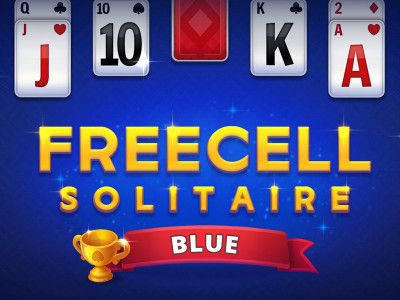
FreeCell Solitaire Blue is a clean, thoughtfully designed version of one of solitaire's most intellectually satisfying variants — one that lives up to FreeCell's central promise: almost every deal is solvable, and the reason you win or lose is almost entirely your own strategic execution. The "Blue" edition distinguishes itself through its polished visual presentation and a particularly player-friendly implementation that keeps every card visible and every decision fully informed.
The game's structure is elegantly logical. All 52 cards are dealt face-up across eight tableau piles from the very first move — there are no hidden cards, no unknowns, no surprise reveals. Every card on the board is information you can use. This full visibility is FreeCell's defining advantage over most solitaire variants and the reason it rewards deep strategic planning so richly. You can — and should — read the entire deal before making your first move.
Four free cells above the tableau serve as your primary planning tool: temporary parking spaces where individual cards can be set aside while you reorganize the tableau beneath them. Four foundation piles await in the upper right, one per suit, each needing to be built from Ace to King. The puzzle is navigating between these two areas — using free cells as a flexible buffer to systematically expose, organize, and deliver cards to their foundations in the right order.
FreeCell Solitaire Blue is the version of this classic game to choose if you want a reliable, visually clean, and genuinely satisfying strategic solitaire experience with no barriers to entry.
Key Details:
| Genre: | Card Game / Solitaire / Puzzle |
| Difficulty Level: | Medium to Hard |
| Average Play Time: | 10–25 minutes per game |
| Best For: | Strategic solitaire players who appreciate full-information planning, methodical problem-solving, and near-guaranteed solvable deals |
2. How to Play Freecell Solitaire Blue
Getting Started:
- All 52 cards are dealt face-up into eight tableau piles — take a moment to read the full layout before making any moves.
- Above the tableau, four free cells (left) and four foundation piles (right) are available.
- Move cards between tableau piles — only the top card of each pile can be moved, and it must go onto a card of higher rank (suit doesn't matter for tableau moves, but only top cards are accessible).
- Park individual cards in free cells to temporarily clear access to cards beneath them.
- Move cards to the foundation piles when they're in suit sequence from Ace upward — completing all four foundations wins the game.
Basic Controls:
- Click to Move (PC): Click a card to select it, then click the destination to place it.
- Touch to Move (Mobile): Tap a card to select it, tap the destination to move it.
- One Card at a Time: Only individual cards (not sequences) can be moved in a single action — plan multi-card moves as a series of individual steps.
Objective: Build all four foundation piles from Ace to King in suit by systematically reorganizing the tableau using the four free cells as temporary storage. Complete all four foundations to win.
3. Freecell Solitaire Blue Features & Highlights
- ✓ All 52 cards visible from deal — complete information from the very first move enables fully planned, deliberate strategy
- ✓ Near-universal solvability — the vast majority of FreeCell deals can be solved with the right approach
- ✓ Four free cells — the strategic core of FreeCell, providing flexible temporary card storage for complex reorganization
- ✓ Clean Blue visual design — polished, easy-to-read card presentation that keeps focus on the strategic puzzle
- ✓ One-card movement rule — forces deliberate, sequential planning rather than bulk moves, preserving strategic depth
4. Freecell Solitaire Blue Tips & Strategies
Beginner Tips:
- Read the whole deal before your first move. With all cards visible, you have a complete picture of the puzzle from the start. Spend 30 seconds identifying where your Aces are, which cards are blocking them, and what sequence of moves would bring them to the foundations.
- Keep free cells available, not full. Every occupied free cell reduces your flexibility. Treat the four cells as a precious limited resource — park cards only when you have a clear plan for where they're going next, and return them to the tableau or foundations as quickly as possible.
- Move Aces and Twos to foundations the moment they're accessible. These low-value cards are never useful in the tableau and always useful on the foundation. There is no reason to delay their placement.
Advanced Strategies:
- Plan the full solution path, not just the next few moves. FreeCell rewards players who can visualize five, seven, or even ten moves ahead. Identify the end state you're working toward and plan the sequence of individual card moves that gets there, rather than making locally reasonable moves that create downstream problems.
- Preserve column flexibility. An empty tableau column is as valuable as an empty free cell — possibly more so, since a column can temporarily hold a sequence rather than just one card. Creating and maintaining empty columns dramatically expands your movement options in complex situations.
- Build same-suit tableau sequences whenever possible. When moving cards between tableau piles, building in-suit sequences (rather than mixed-suit) keeps related cards together and simplifies the process of eventually moving them to foundations as a group.
What to Watch Out For:
- Locking yourself out of a suit. If the cards of one suit become buried in a configuration that requires more free cells than you have available to extract them, you've effectively made that suit's foundation inaccessible. Tracking the accessibility of all four suits simultaneously — not just the ones you're actively working — prevents this.
- Moving the top card without checking what's beneath. The one-card movement rule means you'll frequently need to move a tableau card to access what's under it. Before doing so, confirm there's a valid destination for the card you're temporarily displacing that doesn't create a new problem elsewhere.
5. Freecell Solitaire Blue Game Elements Explained
The Free Cell Architecture: FreeCell Solitaire Blue's four free cells are the game's strategic engine. Each cell can hold exactly one card — removed from its tableau pile and held available for redeployment at any time. The cells function as a controlled extension of your working space: when a card is blocking access to something you need, you park it in a cell, reorganize the area below, then retrieve it to its new position. Managing four cells across a complex deal requires constantly thinking about the "cost" of each cell use — how long a card will sit there, how its absence creates or forecloses options elsewhere, and when it will be redeployed. The four-cell constraint is tight enough to create genuine puzzle difficulty while being generous enough to make nearly every deal solvable with careful play.
The One-Card-at-a-Time Rule: FreeCell Solitaire Blue enforces strict one-card movement — each action moves exactly one card from one location to another. This rule is fundamental to the game's strategic character. It prevents bulk tableau rearrangements and forces every complex sequence to be broken into individual steps. This constraint is why free cells are so valuable: moving a sequence of five cards to a new position requires temporarily parking four of them in cells (or empty columns) while you move the fifth, then rebuilding the sequence. Planning these multi-step move sequences — knowing exactly which card moves first, second, third, and in what order — is the core cognitive skill FreeCell develops. The one-card rule transforms what looks like a simple card-sorting exercise into a genuine sequential logic puzzle.
The Foundation Building System: Four foundation piles occupy the upper-right corner of the board, one designated for each card suit. Each foundation starts empty and must be built in ascending suit sequence from Ace (placed first) through 2, 3, 4... to King (placed last). Only the top card of a tableau pile or a card from a free cell can be moved to a foundation, and only if it's the next card in that suit's sequence. The foundations are your destination and your scoreboard — a game where all four foundations are complete is a won game. Sequencing which suit's foundation to prioritize (when you have the choice) and ensuring that advancing one foundation doesn't create an accessibility problem for another is the high-level planning challenge that separates experienced FreeCell players from beginners.
6. Freecell Solitaire Blue Frequently Asked Questions
Q: What's the difference between FreeCell Solitaire Blue and regular FreeCell?
A: FreeCell Solitaire Blue follows standard FreeCell rules with a polished blue-toned visual design and a clean, accessible interface. The core gameplay — all-visible cards, four free cells, Ace-to-King foundation building — is the same as classic FreeCell.
Q: Can I move sequences of cards at once, or only one card at a time?
A: Only one card at a time. Moving a sequence of cards requires a series of individual moves — typically using free cells and empty columns as intermediate staging areas. Planning multi-card moves as sequential individual steps is a core FreeCell skill.
Q: What happens if a free cell is occupied and I need to park another card?
A: You can only park one card in each free cell — with four cells, you have a maximum of four cards simultaneously parked. If all cells are full, you cannot park another card until one is returned to the tableau or moved to a foundation. Managing cell availability is critical.
Q: Is there a time limit in FreeCell Solitaire Blue?
A: No — FreeCell Solitaire Blue is a pure strategy game with no time pressure. Take as long as you need to plan your moves. The only performance metric is whether you successfully complete all four foundations.
Q: What should I do if I feel completely stuck?
A: Try undoing several moves and approaching from a different earlier decision point. If you have an undo function available, use it liberally — revisiting earlier branching points with new information often reveals a path forward that wasn't visible when you first made those moves.