
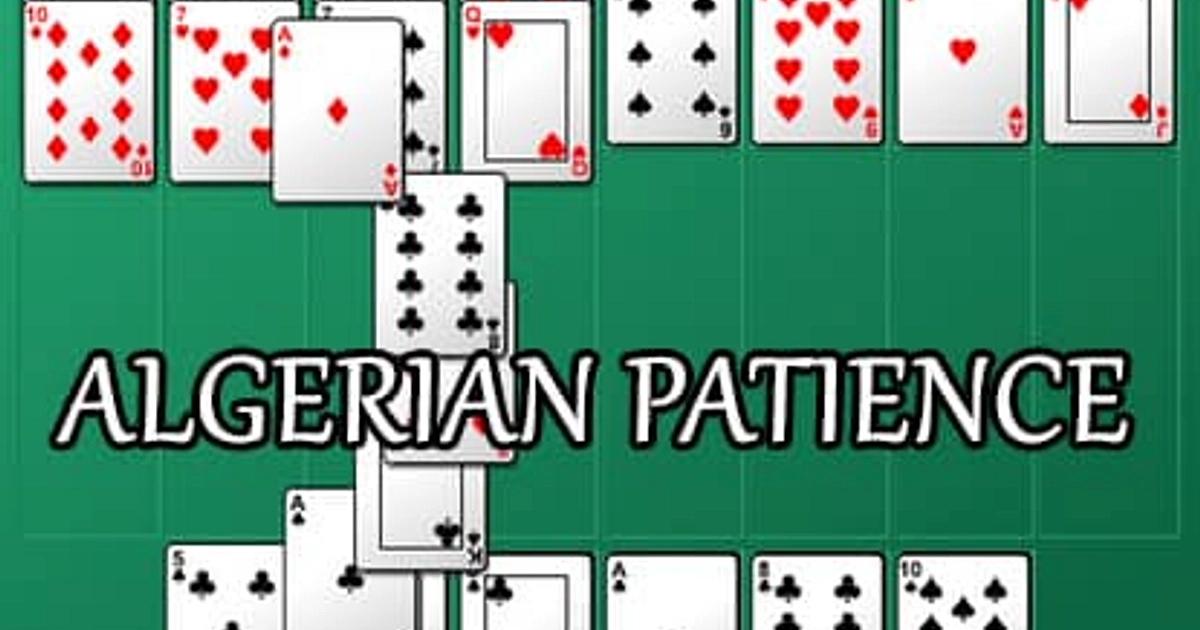









1. Algerijns Patience Game Overview
Algerian Patience is a formidable solitaire card game that earns its name honestly — this is a test of genuine patience, careful planning, and methodical card management. Where most solitaire variants use a single deck, Algerian Patience doubles the ante with two full decks, creating a sprawling, complex card landscape that demands both strategic vision and meticulous execution.
The core challenge is elegant: you must sort both decks simultaneously, but in opposing directions. One full deck must be organized by suit from Ace up to King. The other must run in the opposite direction — King down to Ace. Managing two sets of foundations with conflicting sequences at the same time, while working from a shared pool of cards, creates a uniquely layered puzzle experience unlike any standard solitaire game.
Algerian Patience rewards players who think systematically and plan several moves ahead. Rushing leads to gridlock; careful sequencing leads to satisfying, cascading solutions. It's the kind of game that rewards a quiet mind — each session is a slow, deliberate unraveling of an intricate card puzzle that feels deeply satisfying to solve.
The game is particularly well-suited to players who've mastered common solitaire variants and are looking for a more demanding mental workout. If you find Klondike or Spider Solitaire too easy, Algerian Patience will give your card-sorting instincts a serious challenge.
Key Details:
| Genre: | Card Game / Solitaire / Puzzle |
| Difficulty Level: | Hard |
| Average Play Time: | 20–45 minutes per session |
| Best For: | Experienced solitaire players and card game enthusiasts seeking a deep, methodical mental challenge |
2. How to Play Algerijns Patience
Getting Started:
- Two full decks of 52 cards (104 cards total) are shuffled and dealt.
- Eight foundation piles are set up — four for the first deck, four for the second.
- On the first deck's four foundations, build each suit upward starting from Ace and ending at King.
- On the second deck's four foundations, build each suit downward starting from King and ending at Ace.
- Move cards from the tableau and stockpile to foundations whenever valid placements become available.
Basic Controls:
- Click to Select: Click a card to pick it up.
- Click to Place: Click a valid destination to move the selected card there.
- Drag & Drop: In most versions, you can also drag cards directly to their destination.
Objective: Successfully move all 104 cards from both decks onto their respective foundation piles — four piles ascending from Ace to King, and four piles descending from King to Ace — one suit per pile. Complete all eight foundations to win.
3. Algerijns Patience Features & Highlights
- ✓ Two full decks — dramatically expanded card pool creates a deeper, more complex challenge than standard solitaire
- ✓ Dual-direction foundations — ascending and descending sequences running simultaneously demand parallel strategic thinking
- ✓ Intense mental workout — one of the most cognitively demanding solitaire variants available
- ✓ Classic card game aesthetic — clean, traditional presentation that focuses attention on the puzzle
- ✓ High replay value — every shuffle produces a different configuration and a new strategic challenge
4. Algerijns Patience Tips & Strategies
Beginner Tips:
- Understand both foundation directions before starting. Know which four piles go Ace→King and which go King→Ace. Confusing them early wastes moves and creates unnecessary confusion.
- Prioritize freeing Aces and Kings first. These are your foundation starters. Until an Ace or King is in play on its respective pile, no other cards in that suit sequence can be placed.
- Don't move cards blindly. Every card movement should serve a specific purpose — either directly placing a card on a foundation, or freeing another card that can be placed on a foundation.
Advanced Strategies:
- Work both sequences in parallel. Resist the temptation to fully complete one suit before starting another. Spreading your effort across multiple suits keeps more options open and reduces tableau bottlenecks.
- Anticipate column needs. Open tableau columns are valuable currency. Use them to temporarily park cards that are blocking key sequences, but always have a plan for clearing them again.
- Track duplicate cards. With two decks, every card appears twice. When you place a card, keep mental track of where its duplicate is — it may be exactly what you need for the parallel foundation sequence.
What to Watch Out For:
- Foundation sequence confusion. The ascending and descending sequences can blur together mid-game. If you're unsure which direction a foundation pile runs, check before placing — a wrong placement can be difficult to undo.
- Tableau gridlock. With 104 cards in play, the tableau can become congested quickly. Prioritize moves that create usable space rather than just shuffling cards around the tableau without progressing toward the foundations.
5. Algerijns Patience Game Elements Explained
The Dual Foundation System: The defining feature of Algerian Patience is its eight-pile foundation system divided into two opposing sequences. The first four foundations, one per suit, require you to build from Ace up through 2, 3, 4 ... all the way to King. The second four foundations, also one per suit, require the reverse: starting from King and building down through Queen, Jack, 10 ... down to Ace. These two sequences are completely independent and run simultaneously throughout the game. This duality is the game's central strategic challenge — you're constantly managing two incompatible organizational goals at the same time, using the same pool of cards. A card that serves the ascending sequence of one foundation might be the same card type needed for the descending sequence of another, requiring careful triage of which placement takes priority at any given moment.
The Tableau Management System: With 104 cards spread across a tableau, managing which cards are accessible and which are buried is the primary tactical challenge of Algerian Patience. The tableau consists of several columns of overlapping cards, with only the top (or exposed) cards available for play at any time. To access buried cards, the cards above them must be moved first — creating a cascading dependency problem. Effective tableau management means constantly working to expose the cards you need, keeping key cards from getting buried under long stacks, and maintaining enough flexibility in the tableau to maneuver freely. Running out of accessible moves due to a locked tableau is the most common cause of a lost game.
The Stockpile System: Beyond the initial tableau, Algerian Patience includes a stockpile of remaining cards that can be drawn when tableau options run thin. The stockpile provides a lifeline — new cards that may unlock blocked sequences or fill foundation gaps you couldn't reach from the tableau alone. However, the stockpile is finite, and how you use it matters. Drawing from it recklessly early in the game can leave you without options later. The best approach is to exhaust your tableau options thoroughly before drawing from the stockpile, preserving it as a strategic reserve for when the game truly tightens.
6. Algerijns Patience Frequently Asked Questions
Q: How do I start building the foundations?
A: Place an Ace on one of the four ascending foundation piles to begin building that suit upward. Place a King on one of the four descending foundation piles to begin building that suit downward. Both types must be started before any subsequent cards in those suits can be placed.
Q: What should I do if I run out of moves on the tableau?
A: Draw from the stockpile to introduce new cards into play. If the stockpile is also exhausted and no valid moves remain, the game cannot be completed in its current state.
Q: Can I move cards back from the foundation to the tableau?
A: Most versions of Algerian Patience do not allow cards to be moved back off the foundations. Make sure a foundation placement is correct and intentional before confirming it.
Q: Is Algerian Patience compatible with mobile devices?
A: Yes — the card-clicking and dragging interface works on touchscreens, though a larger screen is recommended given the number of cards in play at once.
Q: How do I know if a game is solvable from the initial deal?
A: Not every deal of Algerian Patience is guaranteed to be solvable. If you've exhausted all moves and the stockpile without completing the foundations, the game may be unwinnable from that starting configuration. Simply start a new game for a fresh deal.