

1. House Of Hazards Game Overview
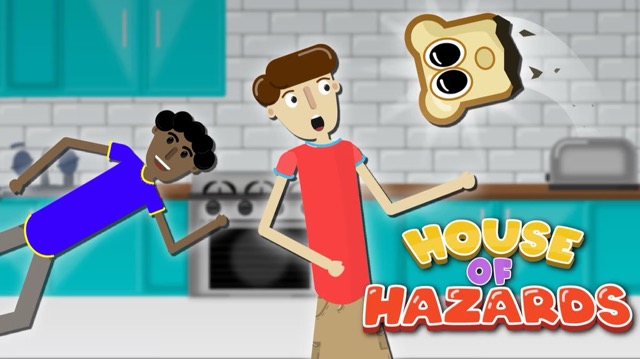
House of Hazards is a gleefully chaotic multiplayer game where a perfectly ordinary house becomes a gauntlet of comedic danger — and surviving it while also sabotaging your friends is the entire point. Up to four players navigate a home that seems determined to destroy everyone in it: floors turn slippery, objects fall from above, electrical hazards spark without warning, and every room presents a fresh set of obstacles designed to produce as many laugh-out-loud moments as genuine victories.
The game's brilliance lies in how it weaponizes the mundane. A kitchen, a living room, a hallway — spaces everyone recognizes — transformed into treacherous obstacle courses where the most ordinary domestic objects become sources of slapstick chaos. Spilled messes need cleaning while everyone else is also slipping in them. Races against timers happen while avoiding swinging chandeliers. Puzzles need solving in rooms that are actively trying to hurt you.
The multiplayer dynamic amplifies everything. Playing solo, House of Hazards is a fun obstacle course. Playing with friends, it becomes something entirely different: you're not just navigating the house, you're watching your friends get launched by a faulty appliance while you narrowly dodge the same fate. The competitive component adds stakes; the cooperative possibilities add teamwork; the unpredictable environment adds the randomness that makes every session feel different.
Character customization, interactive environments where objects can be thrown and manipulated, and mini-games that provide variety between main challenges make House of Hazards one of the most complete casual multiplayer experiences available.
Key Details:
| Genre: | Multiplayer / Party Game / Action |
| Difficulty Level: | Easy to Medium |
| Average Play Time: | 15–30 minutes per session |
| Best For: | Friend groups and casual players who enjoy party games with chaotic multiplayer mayhem, humor, and light competitive challenges |
2. How to Play House Of Hazards
Getting Started:
- Choose your character from the roster of eccentric, customizable options.
- Enter the house — each room presents a specific challenge or hazard to navigate.
- Complete the room's objective (cleaning a mess, reaching a target, solving a puzzle) while avoiding environmental hazards.
- Compete against or cooperate with other players depending on the challenge type.
- Progress through rooms and mini-games, accumulating points from completed challenges.
Basic Controls:
- Movement: Navigate your character through each room's environment.
- Interact: Pick up, throw, or manipulate objects in the environment.
- Jump / Dodge: React to falling objects, slippery floors, and other hazards.
- *(Exact key bindings vary by version — check in-game controls for your device.)*
Objective: Successfully complete each room's challenge while surviving the house's hazards and outperforming your opponents. Navigate the obstacle course of domestic danger across multiple rooms and mini-games to win.
3. House Of Hazards Features & Highlights
- ✓ Up to 4-player multiplayer — local and online play for maximum chaos with friends
- ✓ Unique room-based hazards — every room introduces new obstacle types that keep each session fresh
- ✓ Customizable characters — distinct characters with individual traits and appearance personalization
- ✓ Interactive environment — objects can be picked up, thrown, and used strategically or hilariously
- ✓ Competitive and cooperative mini-games — variety modes that alternate between head-to-head and team challenges
4. House Of Hazards Tips & Strategies
Beginner Tips:
- Observe before rushing. Every room's hazard pattern can be read before you act. Swinging objects, timed drops, and slippery zones all have rhythms — a brief pause to watch the pattern before moving through is worth the second it costs.
- Use objects defensively as well as offensively. The interactive environment means objects you pick up can block incoming hazards, not just be thrown at opponents. A well-placed item between you and a falling object can save a life.
- In cooperative challenges, communicate before acting. Simultaneous actions in the same space often create collisions and chaos. Assign tasks between players — one person handles this side of the room, another handles that side — to avoid friendly interference.
Advanced Strategies:
- Time hazard patterns against opponents, not just yourself. If you know a hazard triggers on a 3-second cycle and a rival is approaching the trigger zone, position yourself to benefit from their misfortune rather than avoiding the zone entirely.
- Learn which mini-games reward individual vs. team play. Some mini-games are zero-sum competitive; others reward coordinated team effort. Applying an aggressive solo strategy to a cooperative mini-game — or playing too cooperatively in a competitive one — leaves points on the table.
- Use the chaos as cover. In chaotic multi-player rooms, other players' hazard interactions create distraction windows. While opponents are dealing with a slippery floor or falling object, you have a brief window of uncontested movement to complete objectives.
What to Watch Out For:
- Getting caught in others' hazard chains. Player-triggered environmental reactions (one player knocking something that hits another, causing a chain of chaos) are frequent in House of Hazards. Stay aware of what other players are doing, not just the static environmental hazards.
- Focusing entirely on competition and missing objectives. Sabotaging opponents is fun, but the primary win condition is completing room objectives — not simply stopping others. Balance your competitive instincts against the task at hand.
5. House Of Hazards Game Elements Explained
The Room Hazard System: Each room in House of Hazards introduces its own suite of environmental hazards that create both challenge and comedy. Slippery floors reduce movement control and cause unpredictable sliding. Falling objects drop from above on timed patterns that require either avoidance or precise timing to navigate through. Electrical hazards spark in specific zones that must be circumvented. These hazards are layered within the room's challenge objective, meaning players must accomplish a task (clean a mess, reach a target, solve a problem) while simultaneously navigating the room's active dangers. The variety of hazard types across different rooms ensures that no two rooms feel mechanically identical — each new space requires reading a fresh set of environmental rules before effective navigation is possible.
The Interactive Environment System: House of Hazards' world is physically interactive in ways that significantly expand player agency beyond simple movement and jumping. Objects throughout each room can be picked up, thrown, and used strategically. This interactivity creates multiple tactical layers: objects can be used offensively against opponents (throwing something at a rival to disrupt them), defensively (using an object as a shield against a falling hazard), structurally (moving objects to create traversal paths), or accidentally (triggering chain reactions that hurt you as much as opponents). The game's funniest and most memorable moments typically emerge from the accidental uses — a thrown object that bounces back unpredictably, a moved piece of furniture that blocks your own exit. This unpredictability is a feature, not a bug, and is central to House of Hazards' identity as a party game.
The Multi-Player Competition and Cooperation System: House of Hazards supports up to four players and structures its challenges across both competitive and cooperative formats. Competitive challenges pit all players directly against each other — first to complete the objective, highest score, or last player standing in a hazard gauntlet. Cooperative mini-games require players to coordinate actions toward a shared goal, rewarding communication and task division. The mix of formats across a session creates dynamic social gameplay: the same players who were sabotaging each other five minutes ago now need to work together, requiring quick recalibration of how you're treating your opponents. This format variety is what keeps multi-player sessions engaging well beyond the novelty of the initial chaos.
6. House Of Hazards Frequently Asked Questions
Q: How many players can play House of Hazards simultaneously?
A: Up to 4 players can participate in each session. The game is designed for 2-4 players, with 4 players producing the maximum chaos and competitive fun.
Q: Can I play House of Hazards alone?
A: Yes, though the game is primarily designed for multiplayer. Single-player mode allows you to navigate the hazards and complete challenges independently, but the social and competitive dynamics that make the game most entertaining require at least one other player.
Q: What makes each room different from the others?
A: Each room introduces its own specific hazard types and challenge objectives. A kitchen has different dangers than a living room or hallway, and the task required to complete each room changes as well. No two rooms are mechanically identical — part of the game's appeal is adapting to each new environment's rules.
Q: Can I throw objects at other players?
A: Yes — the interactive environment allows you to pick up and throw objects at opponents. This is both a legitimate competitive strategy and a reliable source of comedy when the physics produces unintended results.
Q: Is House of Hazards available for online multiplayer or only local?
A: House of Hazards supports both local and online multiplayer. Check the game's mode selection for the available connection options in your specific version.