


1. Solitaire Klondike Game Overview
Solitaire Klondike is the definitive digital version of the world's most played card game — a clean, faithful implementation of the Klondike rules that have defined solo card gaming for generations. No time limits, no arbitrary mechanics layered on top, no interference with the pure strategic pleasure of working 52 cards into four organized foundation piles. Just you, the deck, and the patient logic challenge of sorting cards into their correct sequences.
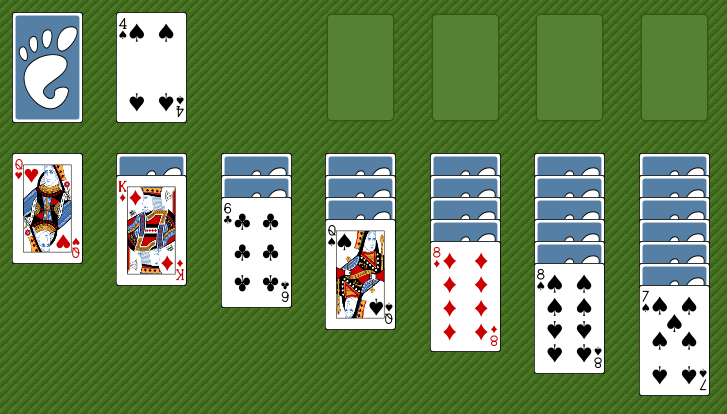
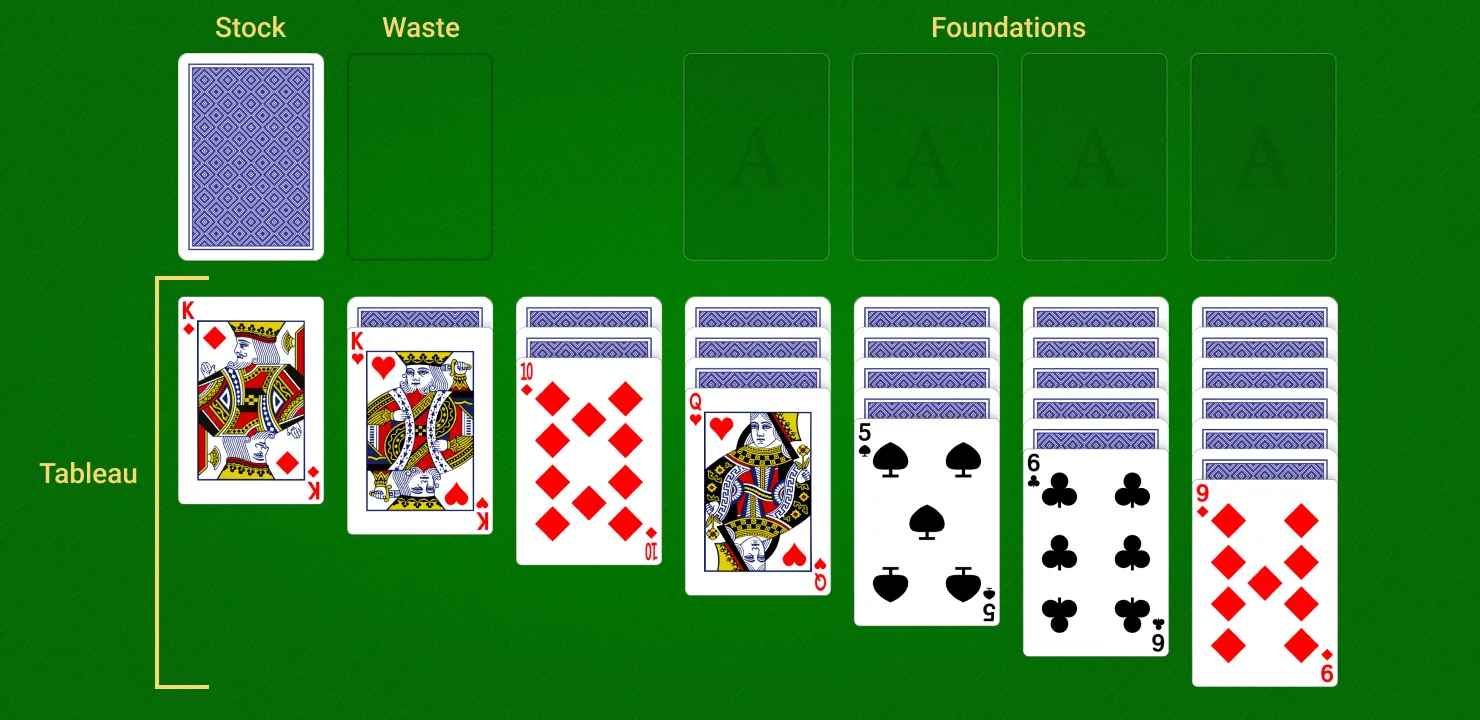
The premise is timeless: cards are dealt across seven tableau columns, most face-down with one face-up card revealing itself from each column. Your task is to arrange them in descending order with alternating colors — red on black, black on red — while moving Aces and progressively higher cards to the four foundation piles in suit. Slowly, through careful sequencing, the hidden cards reveal themselves, and the tableau transforms from chaos to organized clarity.
What makes this version particularly suitable for new and returning players alike is the unlimited time format. There's no clock counting down, no penalty for deliberation, no pressure to play faster than your thinking allows. Solitaire Klondike respects that good card sequencing is a thinking exercise — and thinking takes as long as it takes. Players who want to pause and consider a position before committing to a move have every right to do so.
The mouse-only control scheme keeps the interface friction as low as possible: click to select, click to place. The rules themselves carry all the challenge — and they're more than sufficient.
Key Details:
| Genre: | Card Game / Solitaire |
| Difficulty Level: | Easy to Medium |
| Average Play Time: | 10–25 minutes per game |
| Best For: | All players; an ideal entry point for solitaire newcomers and a reliable daily game for returning veterans |
2. How to Play Solitaire Klondike
Getting Started:
- Seven tableau columns are dealt — column 1 has 1 card, column 7 has 7 cards, each with all but the top card face-down.
- Click a face-up tableau card to select it; click a valid destination to move it.
- Valid tableau destinations are face-up cards that are one rank higher and the opposite color.
- When a face-up card is moved, the face-down card beneath it flips face-up.
- Move Aces to the four foundation piles immediately; continue building each suit from Ace to King.
Basic Controls:
- Mouse Click (Select): Click a face-up card to select it.
- Mouse Click (Move): Click the destination card or pile to place your selected card.
- New Card from Draw Pile: Click the draw pile to reveal additional cards when the tableau has no valid plays.
Key Rules:
- Only face-up (revealed) cards can be moved.
- Cards in the tableau must be arranged largest to smallest with alternating colors.
- New cards can be drawn from the draw pile when needed.
Objective: Move all 52 cards to the four foundation piles — one per suit, each built from Ace up through King — to win the game.
3. Solitaire Klondike Features & Highlights
- ✓ Unlimited time — completely pressure-free play that respects deliberate, thoughtful card sequencing
- ✓ Classic Klondike rules — the world's most recognized solitaire format, faithfully implemented
- ✓ Face-down card revelation — hidden cards reveal progressively, creating a satisfying information-discovery loop
- ✓ Seven-column tableau — the iconic deal structure that defines Klondike solitaire's distinctive appearance
- ✓ Draw pile supplementation — additional cards available when the tableau reaches its options limit
4. Solitaire Klondike Tips & Strategies
Beginner Tips:
- Move Aces to foundations the moment they appear. An Ace in the tableau is only waiting to become a foundation starter. There's never a reason to leave one in the tableau when a foundation pile can receive it.
- Focus on revealing face-down cards. Every face-down card in the tableau is an unknown that limits your planning. Any move that reveals a hidden card is almost always worth making — more visible cards means more available plays.
- Don't empty a tableau column without a King ready. An empty column is a valuable staging area, but only Kings can start a new column sequence. Clearing a column with no King to immediately fill it wastes that flexibility.
Advanced Strategies:
- Plan two or three moves ahead, not just one. The best solitaire moves create the best subsequent moves. Before clicking, trace what your move enables — does it reveal a card you need, create a sequence opportunity, or open a column for a King you have ready?
- Sequence your foundations together. If one suit is at 8 on the foundation and another is at 3, the lagging suit's low cards might be needed as tableau stepping stones. Avoid sending a card to the foundation if keeping it in the tableau opens more options.
- Manage your draw pile cycles. If your version limits draw pile passes, don't burn through the pile carelessly. Draw only when the tableau genuinely has no valid plays, and try to reach as far as possible through tableau moves before returning to the draw pile.
What to Watch Out For:
- Alternating-color errors. The most common beginner mistake is placing a card on a same-color card rather than the required opposite color. Double-check color before every placement — a color error can disrupt a sequence you've spent several moves building.
- The buried Ace trap. If an Ace is buried deeply under face-down cards in a column with many face-downs above it, it may take many moves to reach. Identify buried Aces early and prioritize the column that contains them for systematic uncovering.
5. Solitaire Klondike Game Elements Explained
The Seven-Column Tableau System: Klondike solitaire's deal structure is one of the most recognized layouts in card gaming. Seven columns are dealt from left to right with increasing depth — column 1 has 1 card (face-up), column 2 has 2 cards (1 face-down, 1 face-up), continuing to column 7 which has 7 cards (6 face-down, 1 face-up). This graduated structure means the rightmost columns have the most hidden information — and uncovering those deep face-down cards typically requires the most preparation. The visual asymmetry of the deal creates immediate strategic differentiation: the leftmost columns open quickly; the rightmost columns unfold slowly and require sustained uncovering work to reach their full potential.
The Alternating-Color Movement System: Klondike solitaire's defining mechanical rule is the alternating-color requirement for tableau card placement. Face-up cards can only be placed on other face-up tableau cards that are one rank higher AND the opposite color — a red card goes on a black card, a black card goes on a red card, regardless of the specific suit. This cross-suit alternating rule creates dependencies between suits that pure same-color solitaire variants don't have: a red 8 and a red 7 can't form a tableau sequence together, even though they're consecutive ranks. This constraint is what gives Klondike its characteristic strategic texture and what makes it genuinely more demanding than it first appears.
The Face-Down Revelation System: The game's most satisfying mechanic is the progressive reveal of face-down cards as face-up cards above them are moved away. Each face-down card conceals information — possibly the Ace you've been waiting for, the color-suit bridge that unlocks a stalled sequence, or a high card that enables a new tableau column. The act of revealing a face-down card and immediately recognizing its value to your current board state is the primary cognitive reward of Klondike solitaire. Experienced players develop a sense for which columns to prioritize based on how many face-down cards they contain and how deep the potentially valuable cards might be — directing their sequencing efforts toward the highest-information-density columns first.
6. Solitaire Klondike Frequently Asked Questions
Q: What does "alternating colors" mean for card placement?
A: Cards placed in the tableau must alternate between red suits (hearts and diamonds) and black suits (clubs and spades). A red card can only go on a black card, and vice versa — AND the destination card must be one rank higher than the card being placed. Both conditions (color and rank) must be satisfied.
Q: Can I move multiple cards at once?
A: Yes — if a sequence of cards in the tableau is in correct descending alternating-color order, you can move them as a group to a valid destination. The whole sequence moves together in one action.
Q: What can I place in an empty tableau column?
A: Only Kings (and any sequence of cards built below a King) can start an empty column. No other card can begin a new column.
Q: Is there a time limit?
A: No — Solitaire Klondike has unlimited time. Play at whatever pace feels comfortable. There's no timer counting down and no penalty for taking time to think through your moves.
Q: Can every Klondike deal be won?
A: No — a meaningful percentage of Klondike deals are mathematically unwinnable regardless of strategic skill. If you've exhausted all possible moves and the draw pile, the specific deal may simply be uncompletable. Starting a new game with a fresh deal is the right response to a stuck position with no remaining moves.