



1. Super Hexbee Merger Game Overview
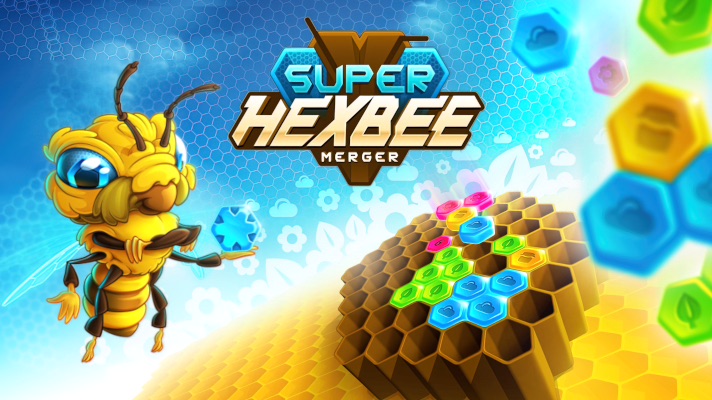
Super Hexbee Merger is a honeycomb hex puzzle that takes the familiar color-matching block game formula and rebuilds it from the ground up with hexagonal cells — and that single geometric change creates a meaningfully different strategic experience. Where square grids present four adjacency directions, hexagonal cells present six. Matches that would be impossible in a square grid become available through diagonal adjacency; cluster shapes that would be obvious on a square grid require genuinely fresh spatial thinking on the hexagonal honeycomb.
The bee aesthetic isn't just thematic decoration — it gives the game's honeycomb structure a personality and visual coherence that makes the puzzle feel intentional rather than abstract. You're building a hex color cluster for the bees, and the honeycomb filling naturally creates satisfying visual shapes as color groups merge.
The pre-placement color rearrangement system is Super Hexbee Merger's most distinctive feature. Before committing a block to the honeycomb, you can rearrange the colored squares within the block — changing which color is in which position while keeping the overall block shape identical. This flexibility creates a moment of genuine puzzle-solving before each placement: given this block's shape and its colored squares, what configuration will create the best adjacency opportunities on the current board? This pre-placement decision is where the game's strategic depth actually lives.
The timed session format adds urgency that escalates naturally as the honeycomb fills — more cells occupied means less space and fewer valid placements, creating the pressure curve that distinguishes expert sessions from average ones.
Key Details:
| Genre: | Puzzle / Hex Match / Strategy |
| Difficulty Level: | Medium to Hard |
| Average Play Time: | 5–15 minutes per session |
| Best For: | Puzzle players who enjoy color-matching block games and want a fresh hexagonal format with pre-placement strategy |
2. How to Play Super Hexbee Merger
Getting Started:
- You're given a block of colored hexagons (green, blue, or pink) to place on the honeycomb.
- Before placing, rearrange the colored squares within the block for optimal adjacency — the shape doesn't change, only the color positions.
- Drag and drop the block into an empty area of the honeycomb.
- Adjacent same-colored hexagons score points — the more adjacent same-color cells, the higher the combo.
- When a combo explodes, you earn a power hex of that color — combining it with other same-color hexes eliminates that color from the board.
Basic Controls:
- PC: Click and drag the left mouse button to move and place blocks.
- Mobile: Tap and drag with your finger to place blocks.
- Pre-Placement Rearrangement: Interact with the block before placing to change the color positions within it.
Objective: Score as many points as possible before time runs out or the honeycomb fills. Create large same-color adjacency clusters for combo points. Use power hexes strategically to clear color groups and maintain board space.
3. Super Hexbee Merger Features & Highlights
- ✓ Pre-placement color rearrangement — reposition colored squares within a block before placing for optimal adjacency
- ✓ Hexagonal honeycomb grid — six-sided adjacency creates spatial relationships unavailable in square grids
- ✓ Three color types — green, blue, and pink create distinct cluster-building tracks
- ✓ Power hex system — combo explosions earn color-specific power hexes that eliminate entire color groups
- ✓ Timed session format — race against the clock for maximum score before time expires
4. Super Hexbee Merger Tips & Strategies
Beginner Tips:
- Always rearrange the block before placing. The pre-placement rearrangement is free — there's no cost to using it. Always evaluate whether a different color configuration would create better adjacency before committing to any placement.
- Place blocks adjacent to matching colors, not into open space. A block placed in open honeycomb space earns no adjacency points regardless of how it's configured. Find existing clusters of your block's dominant color and place next to them.
- Focus on building one color cluster at a time. Trying to build all three color clusters simultaneously creates scattered, disconnected groups that score individually rather than combinatorially. Pick your strongest color and build it toward a large cluster.
Advanced Strategies:
- Set up power hex triggers deliberately. Combo explosions earn power hexes — and power hexes, when combined with enough same-color cells, clear that color from the board, freeing substantial honeycomb space. Engineering situations where a combo explosion triggers a power hex clear creates the most dramatic board resets.
- Use hexagonal adjacency's diagonal dimension. Hexagonal grids have six adjacency directions versus four in square grids. Clusters that look disconnected in square-grid thinking may actually be adjacent through the hex grid's diagonal connections. Think in six directions, not four.
- Protect board space in the honeycomb's center. The center of the honeycomb has maximum six-direction adjacency. Placing blocks in the center creates the most potential adjacency connections. Corner placements have fewer adjacency directions and are strategically weaker for cluster building.
What to Watch Out For:
- Fragmented color distribution. Placing blocks without adjacency to matching colors creates isolated color fragments — individual hexes or small groups that are hard to expand into scoring clusters. Resist placing in convenient but non-adjacent positions.
- Ignoring the time display. The timer in the top right corner is active from the start. Players who focus entirely on the board without periodic time checks sometimes miss the final rush window when maximum-scoring plays become critical.
5. Super Hexbee Merger Game Elements Explained
The Pre-Placement Rearrangement System: Super Hexbee Merger's most strategically distinctive feature is the ability to rearrange colored squares within a block before placing it on the honeycomb. Each block arrives with a fixed geometric shape and pre-colored hexagonal cells — but before dropping it onto the board, you can change which cell of the block is which color. The shape remains constant; only the color distribution within the shape changes. This rearrangement creates a two-stage decision process for each placement: first, decide where to place the block on the honeycomb; second, decide how to configure the colors within the block for maximum adjacency benefit. Players who skip the rearrangement step and place blocks as-received sacrifice significant scoring potential on every turn.
The Hexagonal Adjacency System: The honeycomb grid's hexagonal structure creates six adjacency directions for each cell: up-left, up-right, left, right, down-left, and down-right. This six-direction adjacency is the geometric foundation of what makes Super Hexbee Merger strategically different from square-grid color matching. Clusters in hex grids can form shapes — diamonds, triangles, elongated hexagons — that create natural expansion directions different from the rectangular clusters of square grids. Understanding which cell positions maximize your cluster's adjacency potential requires developing new spatial intuition specifically for hexagonal geometry. Players who map square-grid thinking onto the hex board consistently leave adjacency opportunities unclaimed.
The Power Hex and Combo System: When an adjacency cluster of same-color hexes explodes into a combo, two rewards trigger simultaneously. First, the combo score increases based on the number of same-color adjacent cells eliminated — larger combos produce exponentially higher scores. Second, a power hex of that color is added to your available blocks. Power hexes are special pieces that, when placed adjacent to enough same-color regular hexes, eliminate all hexes of that color from the honeycomb board simultaneously. This mass elimination is the game's highest-impact single move — it can clear dozens of cells at once, dramatically resetting the space pressure of a filling honeycomb. The strategic decision of when to deploy a power hex (versus placing it in a weaker position earlier) is one of the game's most consequential single choices.
6. Super Hexbee Merger Frequently Asked Questions
Q: How does the pre-placement rearrangement work?
A: Before you drop a block onto the honeycomb, you can change which colored hexagonal cell occupies which position within the block. The block's overall shape stays the same — only the color arrangement within it changes. This is free to use and should be evaluated before every placement.
Q: What are power hexes and how do I use them?
A: Power hexes are special pieces earned when a same-color combo explodes. When placed adjacent to other same-color hexes on the board, a power hex eliminates all hexes of that color from the honeycomb. Use them when you have a large concentration of one color to clear significant board space.
Q: What are the three colors in Super Hexbee Merger?
A: Green, blue, and pink — three distinct color tracks for cluster-building. Each block contains one or more of these colors in its hexagonal cells, and same-color adjacency across all three tracks generates combo scores.
Q: When does the game end?
A: The timer in the top right corner counts down the session. When time runs out, the game ends and your final score is calculated. The honeycomb filling completely may also end your ability to place new blocks before the timer does.
Q: Is Super Hexbee Merger harder than square-grid block games like Tetris or Block Blast?
A: The hexagonal grid creates a different kind of challenge — not necessarily harder, but spatially unfamiliar if you're accustomed to square grids. The six adjacency directions and the pre-placement rearrangement system add dimensions of decision-making that square-grid games don't have. Expect a learning curve as you develop hex-grid spatial intuition.