



1. Peg Solitaire Game Overview
Peg Solitaire is one of the oldest and most intellectually satisfying solo puzzle games in existence — a game with over 300 years of documented history that remains genuinely challenging and rewarding to this day. The premise is stark: a board full of pegs, most removed by the time you're done, with only one peg remaining as the mark of a successful solve. Getting there requires planning, foresight, and a deep understanding of the game's constraint mechanics.
The movement rule is what makes Peg Solitaire a genuine puzzle rather than a simple clearing exercise. A peg can only be removed by having another peg jump over it — and that jump requires an empty space on the other side of the target peg. This means every move simultaneously places a peg in a new position, removes the jumped peg, and changes the accessibility landscape for all subsequent moves. Plan well and you build toward a clear path to a single final peg; plan poorly and you find yourself with isolated pegs that can no longer be jumped — and a board that can't be fully cleared.
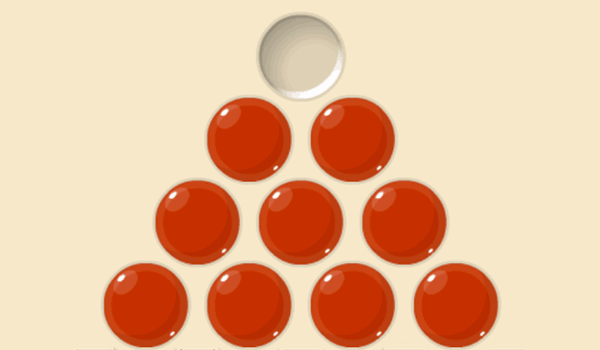
The online version extends the classic experience with four distinct board shapes: triangle, square, cross, and diamond. Each shape creates a completely different peg distribution, movement dynamic, and solution pathway — effectively four separate puzzles built on the same rule set. The triangle board has its own classical solutions; the cross is the most famous traditional format; the diamond and square offer further geometric variety that keeps experienced players discovering new challenges.
For puzzle lovers who want a pure, mathematically satisfying challenge with deep historical roots, Peg Solitaire is a timeless choice.
Key Details:
| Genre: | Puzzle / Logic / Classic Board Game |
| Difficulty Level: | Hard |
| Average Play Time: | 10–30 minutes per board (depending on shape) |
| Best For: | Logic puzzle enthusiasts who enjoy spatial reasoning challenges with historical depth and no time pressure |
2. How to Play Peg Solitaire
Getting Started:
- Select your preferred board shape: triangle, square, cross, or diamond.
- The board begins nearly full of pegs, with one or more empty spaces to start the first jump.
- Click a peg to select it, then click an empty space two positions away in the same line — the peg between the two positions is removed.
- Continue making valid jumps to remove pegs from the board.
- Clear all pegs except one to solve the puzzle.
Basic Controls:
- Click Peg (Select): Click a peg to select it as the jumping piece.
- Click Destination: Click a valid empty space two positions away to complete the jump and remove the intermediate peg.
- Question Mark Button: Access detailed instructions and movement guidance at any time.
Objective: Remove pegs from the board one jump at a time until only a single peg remains. Each jump removes exactly one peg — success requires clearing the entire board minus one.
3. Peg Solitaire Features & Highlights
- ✓ Four board shapes — triangle, square, cross, and diamond each create distinct puzzles with different solution paths
- ✓ 300+ year historical pedigree — one of the oldest documented solo puzzle games in the world
- ✓ Pure spatial logic challenge — no timer, no randomness, only the constraint puzzle of valid jump sequences
- ✓ In-game instruction access — the Question Mark button provides movement guidance whenever needed
- ✓ Online anytime accessibility — browser-based play with no download required
4. Peg Solitaire Tips & Strategies
Beginner Tips:
- Think backward as well as forward. Before making any jump, ask not just "where does this peg go?" but "what does removing this peg enable for the next two moves?" Planning backward from the desired end state (one peg remaining) is often more productive than planning forward from the current state.
- Avoid creating isolated pegs early. An isolated peg — one with no adjacent pegs and no empty landing space on either side — can never be jumped and becomes a permanent obstruction. Identify potential isolation situations before they form and reroute your jump sequence to prevent them.
- Keep the center accessible. On cross and square boards, the center positions connect to the most jump paths. Pegs that fall in corner or edge areas with limited connectivity become hard to remove — prioritize jump sequences that keep central positions flexible.
Advanced Strategies:
- Learn classical solution patterns. Peg Solitaire has well-documented solution patterns for each board shape, particularly the cross. These patterns don't tell you exactly which peg to jump each turn, but they establish sequencing principles (which areas to clear in which order) that dramatically improve your success rate.
- Work from the edges inward. Clearing edge pegs is often more difficult than clearing central pegs because edge positions have fewer valid jump directions. Remove edge pegs early when they can be cleared cleanly, before the surrounding board state makes edge removal impossible.
- Build toward a "broom" formation. In the cross board's classical solution, one useful intermediate goal is consolidating remaining pegs into a specific formation that can be swept clean in a final sequence of chained jumps. Recognizing and aiming for such formation states is the mark of advanced play.
What to Watch Out For:
- Jump exhaustion. If no peg on the board has a valid jump available (either no peg to jump over or no empty landing space on the other side), the puzzle cannot continue regardless of how many pegs remain. This is the most common failure state — and it almost always results from a sequence decision made several moves earlier.
- The triangle board's unique movement constraints. Triangle boards don't have the same four-directional movement as cross and square boards — their triangular geometry creates diagonal constraints that require completely different thinking. Approach the triangle board as a fresh puzzle rather than applying cross-board strategies.
5. Peg Solitaire Game Elements Explained
The Jump-and-Remove Mechanic: Peg Solitaire's entire challenge flows from one simple rule: a peg can move by jumping over an adjacent peg to land in an empty space on the other side, removing the jumped peg in the process. This mechanic requires three conditions to be simultaneously true: a peg to jump with, an adjacent peg to jump over, and an empty space landing on the far side. When all three conditions align, the jump is valid. This seemingly simple constraint generates enormous complexity across a full board — each jump changes the conditions for every other peg on the board, meaning the sequence of jumps determines whether the board can be fully cleared. An early jump that seems advantageous can create isolation problems several moves later; a jump that seems suboptimal can preserve the path to a successful final position.
The Four Board Shape System: Peg Solitaire's online implementation offers four distinct board geometries, each of which creates a completely different puzzle. The cross board is the most famous traditional format — a plus-sign shape that has been studied by mathematicians and puzzle enthusiasts for centuries. The triangle board uses triangular geometry with different directional movement constraints, creating an entirely new set of solution challenges. The square board provides the maximum number of peg positions and movement paths, making it the most complex format. The diamond board creates an intermediate challenge with its own geometric character. These four shapes aren't just visual variety — each requires distinct strategic approaches and provides a fresh solution challenge even for players who have mastered another format.
The Historical Legacy: Peg Solitaire is documented as far back as the late 17th century in France, where the first known board description appeared. It subsequently became popular across Europe, with England eventually adopting the cross-shaped board as its standard format. The game's mathematical properties have been analyzed extensively — which board configurations are solvable, which target positions can be achieved from which starting states, and what solution patterns are most reliable. This mathematical depth gives Peg Solitaire a layer of historical and intellectual significance unusual in casual puzzle games. Playing it online connects you to a problem that has occupied mathematicians and puzzle enthusiasts for over three centuries — a uniquely satisfying context for a logic challenge.
6. Peg Solitaire Frequently Asked Questions
Q: How do I make a valid jump?
A: Click a peg to select it. Valid jump destinations highlight — click an empty space exactly two positions away (with another peg in the space between) to complete the jump. The intermediate peg is removed automatically.
Q: What happens if I can't make any valid jumps?
A: If no peg on the board has a valid jump available, the puzzle ends at its current state — you've run out of moves. If more than one peg remains, the puzzle wasn't fully solved this attempt. Restart with a different jump sequence from the beginning.
Q: Do I need to end with the final peg in a specific position?
A: The basic win condition is clearing all pegs except one — the position of that final peg varies by board shape. Some traditional formats have a "perfect" solution where the final peg lands in the center, but any single remaining peg counts as a solved puzzle.
Q: Which board shape is the easiest to start with?
A: The cross board has the most documented solution strategies and is the most studied format — making it the best starting point for players new to Peg Solitaire. The triangle board is often considered the most immediately forgiving because of its smaller peg count.
Q: Is there an undo function?
A: Check your version's interface for an undo option. Many online Peg Solitaire implementations include an undo button that reverses the last jump, allowing you to explore different sequence branches without restarting from scratch.