

1. Klondike Solitaire Turn One Game Overview
Klondike Solitaire Turn One is the purest, most player-favorable version of the world's most famous card game. Where some Klondike variants draw three stockpile cards at a time (revealing only the top card for play), Turn One draws a single card per click — giving you direct, immediate access to every card in the stockpile as it cycles through. This difference transforms stockpile management from a limiting factor into a fully transparent resource, shifting the game's difficulty balance firmly toward strategic planning rather than luck.
The appeal of Turn One is the strategic completeness it enables. When every stockpile card is directly accessible one at a time, the gap between "what I can see" and "what I can use" narrows dramatically. You can plan multiple moves ahead with high confidence, knowing that the card you need from the stockpile is accessible when you reach it rather than hidden behind two others you don't need. This makes Turn One the version most suited to players who want to feel that their strategic decisions — rather than the draw sequence — are the primary determinant of success.
The core rules are identical to all Klondike variants: build the tableau in descending rank with alternating colors, send Aces to the foundations, and build each suit from Ace to King. Uncover face-down cards to reveal new possibilities. Manage the stockpile to supplement what the tableau can't provide. Win by completing all four foundation piles.
Turn One is an ideal starting version for new solitaire players and a satisfying daily practice game for experienced players who prefer their strategic skill to be the primary variable.
Key Details:
| Genre: | Card Game / Solitaire |
| Difficulty Level: | Easy |
| Average Play Time: | 10–20 minutes per game |
| Best For: | Solitaire players who prefer strategy over luck; excellent for new players and those who want clean, player-friendly Klondike access |
2. How to Play Klondike Solitaire Turn One
Getting Started:
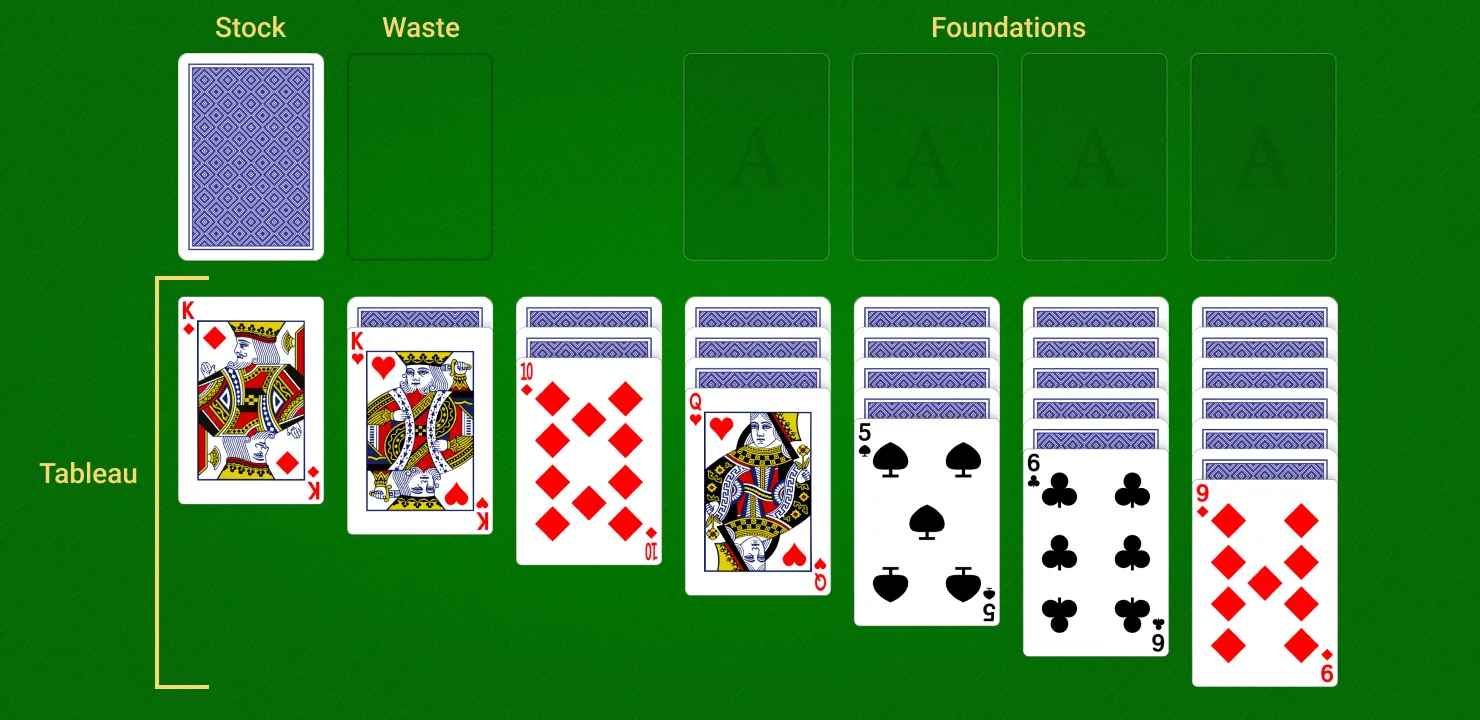
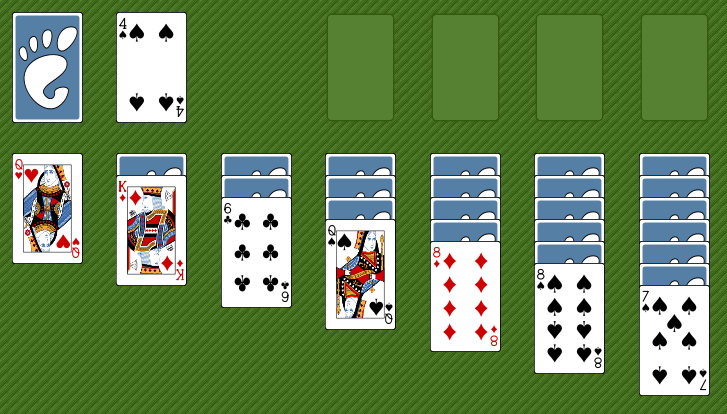
- Cards are dealt into 7 tableau columns — each column has one face-up card on top, with face-down cards beneath.
- Move face-up tableau cards onto cards that are one rank higher and opposite in color.
- When a face-up card moves, the face-down card beneath it flips face-up.
- Click the stockpile to draw one card at a time — play it immediately or cycle to the next.
- Move Aces to the four foundation piles and build each suit Ace through King to win.
Basic Controls:
- Click to Select: Click a face-up card to select it.
- Click Destination: Click a valid tableau or foundation position to move the selected card.
- Click Stockpile: Draw one card at a time — use it or cycle forward.
Objective: Build all four foundation piles from Ace to King in suit. Use the turn-one stockpile draw (one card at a time) to access every card in your reserve directly, planning your tableau organization for maximum efficiency.
3. Klondike Solitaire Turn One Features & Highlights
- ✓ Single-card stockpile draw — every stockpile card is directly accessible one at a time, maximizing strategic transparency
- ✓ Strategy-forward design — Turn One's format makes player decisions the primary win factor over random draw sequences
- ✓ Classic Klondike rules — all standard tableau movement, foundation building, and alternating-color mechanics intact
- ✓ Ideal for new players — the most accessible Klondike format with the highest natural win rate
- ✓ Patient, deliberate gameplay — the single-card draw rewards careful planning and multi-move foresight
4. Klondike Solitaire Turn One Tips & Strategies
Beginner Tips:
- Cycle through the stockpile completely before deciding what to play. In Turn One, you can see every card in the stockpile before committing to a play. Take advantage of this — cycling through to understand what's available gives you planning information that turn-three variants don't offer.
- Prioritize uncovering face-down cards in longer columns. Columns with more face-down cards hide more information and potential. Moving face-up cards to reveal face-down ones (even at the cost of a non-ideal tableau position) is often worth the short-term placement inefficiency.
- Use the stockpile as a planning tool, not a rescue. Because Turn One lets you see each stockpile card individually, you can identify which card you'll need next and plan your tableau moves to be in a position to use it when you draw it.
Advanced Strategies:
- Count your cycling to track card positions. Since cards cycle through the stockpile in order and one at a time, you can track approximately when a needed card will appear in future cycles. Planning tableau moves around anticipated stockpile draws allows precise multi-step sequencing that Turn Three can't support.
- Build long tableau sequences before sending to foundations. A long same-suit sequence in the tableau is flexible — it can move to create space, expose face-down cards, and be sent to the foundation when ready. Rushing individual cards to foundations can break up useful sequence structures you still need.
- Empty columns strategically. In Turn One, the stockpile's transparency makes it easier to time when you'll have a King available for an empty column. Clear columns when a King from the stockpile is near in the cycle, rather than clearing and waiting indefinitely for one to appear.
What to Watch Out For:
- Excessive stockpile cycling. Even in Turn One, the stockpile recycles are typically limited. Drawing through the stockpile repeatedly without playing cards burns your recycling allowance. Only cycle when the tableau genuinely has no viable plays — don't cycle out of impatience.
- Tableau dependency chains. The alternating-color rule creates dependencies where moving one sequence requires a specific card elsewhere to be in place. Plan moves that don't create circular dependencies — situations where card A needs card B to move, and card B needs card A to move first.
5. Klondike Solitaire Turn One Game Elements Explained
The Turn One Stockpile Mechanic: The defining feature of Klondike Solitaire Turn One is its single-card stockpile draw. When you click the stockpile, exactly one card is revealed — either playable to the tableau or foundation, or set aside as the new visible stockpile top. If not playable, another click reveals the next card. This one-at-a-time access means you can cycle through the entire stockpile to survey its contents before committing to any play — a strategic advantage that Turn Three variants (which skip every other card, making most of the stockpile temporarily inaccessible) cannot provide. The transparency of Turn One makes it the most skill-dominant Klondike format, since better strategic decisions consistently produce better outcomes rather than better outcomes depending partly on which stockpile cards happen to surface.
The Descending Alternating-Color Tableau System: Klondike Solitaire Turn One uses the standard Klondike tableau building rules: face-up cards can be placed on other face-up tableau cards that are exactly one rank higher and opposite in color. Red cards (hearts and diamonds) go on black cards (clubs and spades) and vice versa; rank must be exactly one step lower. This cross-suit alternating constraint creates tableau interdependencies that make planning across all seven columns simultaneously necessary — the move that solves one column's problem may create another's. Sequences of correctly ordered cards can move as a unit, making longer sequences more flexible as positional tools while also making them harder to build correctly in the first place.
The Foundation Building and Win System: Four foundation piles wait in the upper right corner of the board — one per suit (hearts, diamonds, clubs, spades). Each foundation starts empty and must be built in strict ascending suit sequence from Ace through 2, 3, 4... to King. Only one card can be sent to each foundation at a time, and only the next card in that suit's sequence is accepted. The game is won when all four foundations are complete — all 52 cards in their correct suit sequences from Ace to King. Foundation management in Turn One involves deciding when to send a card to the foundation versus keeping it in the tableau for flexibility: a low card in the tableau can still serve as a building target for higher cards, whereas a card sent to the foundation is locked there.
6. Klondike Solitaire Turn One Frequently Asked Questions
Q: What does "Turn One" mean?
A: "Turn One" refers to the stockpile draw mechanic — each click of the stockpile reveals exactly one card. This is contrasted with "Turn Three" variants where each click reveals three cards but only the top one is immediately playable. Turn One maximizes card access; Turn Three is more challenging because it limits stockpile accessibility.
Q: Can I see all the stockpile cards without playing them?
A: Yes — cycling through the stockpile one card at a time lets you survey all available cards before committing to a play. This information advantage is one of Turn One's primary features and is why it's considered more strategic and player-favorable than Turn Three.
Q: Is Turn One easier than other Klondike versions?
A: Yes — Turn One has the highest natural win rate among Klondike variants because every stockpile card is directly accessible. Strategic skill determines outcomes more than in Turn Three, where the draw sequence limits what you can access at any given moment.
Q: How many times can I cycle through the stockpile?
A: Recycling limits vary by implementation. Most Turn One versions allow unlimited recycling, though some limit recycles for added challenge. Check your specific version's rules for the recycling allowance.
Q: What should I do when both the tableau and the stockpile cycle offer no valid plays?
A: If you've cycled through the full stockpile and found no playable cards while the tableau offers no valid moves, the game cannot be completed from the current state. This is relatively rare in Turn One but does occur — start a new game when this happens.