



1. Crescent Solitaire Game Overview
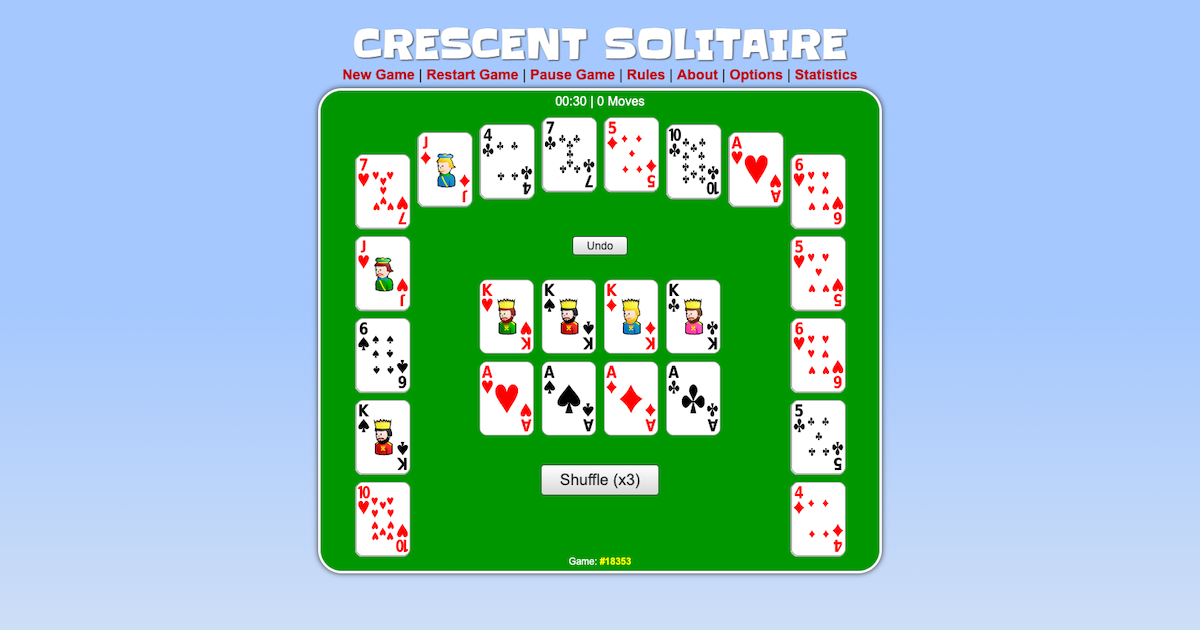
Crescent Solitaire is a beautifully distinctive solitaire variant that puts a cosmic spin on the card-sorting tradition. Set against an outer space backdrop complete with relaxing ambient sounds, the game challenges you to sort a full deck of cards into eight central foundation piles — four ascending from Ace to King, four descending from King to Ace — all within a 20-minute time limit. It's elegant, atmospheric, and more strategically demanding than it first appears.
The outer space setting isn't just cosmetic — it gives the game a genuinely serene, focused atmosphere that makes even tense near-the-wire finishes feel strangely calm. You're sorting cards against the stars, with an impressive visual backdrop and soft audio that keeps the experience pleasant throughout.
Strategically, Crescent Solitaire balances careful planning with the tactical pressure of a timer. Unlike open-ended solitaire games where you can think indefinitely, here you must move efficiently — deliberating too long burns time that a more aggressive player would have used to clear cards. The tableau movement rules (same-suit, one step higher or lower) create a satisfying constraint that governs how cards can be repositioned before they're ready for the foundations. And the reshuffle mechanic provides a lifeline when the tableau feels locked — at the cost of precious seconds.
For players who love solitaire but want a more structured, time-conscious challenge with a distinctive aesthetic, Crescent Solitaire hits a sweet spot that few variants manage.
Key Details:
| Genre: | Card Game / Solitaire |
| Difficulty Level: | Medium to Hard |
| Average Play Time: | 15–20 minutes per game |
| Best For: | Solitaire fans seeking a time-challenged variant with dual-direction foundation building and a relaxing outer space aesthetic |
2. How to Play Crescent Solitaire
Getting Started:
- Cards are dealt across the tableau in the crescent formation surrounding the eight central foundation piles.
- Your goal: build four foundation piles ascending (Ace → King) and four descending (King → Ace), one per suit each.
- Move tableau cards onto other tableau cards of the same suit that are one higher or one lower in value.
- When a card is ready for a foundation (Ace for ascending piles, King for descending piles), click it to place it.
- If the tableau becomes stuck, use the reshuffle option to redistribute cards — but use it sparingly given the 20-minute limit.
Basic Controls:
- Click to Move: Click a face-up tableau card to select it, then click a valid destination to move it.
- Click to Foundation: Click a card directly onto its matching foundation pile when it's ready.
- Reshuffle: Activate the reshuffle to redistribute remaining tableau cards when no valid moves remain.
Objective: Sort all cards into the eight foundation piles — four suits ascending Ace to King, four suits descending King to Ace — within 20 minutes. Maximize your score by completing as many foundations as possible before time expires.
3. Crescent Solitaire Features & Highlights
- ✓ Dual-direction foundation building — ascending and descending piles running simultaneously create a richer sorting challenge than standard solitaire
- ✓ 20-minute time limit — the countdown adds urgency and pace without making the game feel rushed in its early stages
- ✓ Reshuffle mechanic — a tactical lifeline for locked tableaux, balanced by the cost of using it during a timed game
- ✓ Outer space aesthetic — impressive visual backdrop and relaxing ambient audio create a serene, focused atmosphere
- ✓ Score optimization — efficiency and completion percentage both factor into your final score, rewarding clean play
4. Crescent Solitaire Tips & Strategies
Beginner Tips:
- Foundation-ready cards go immediately. The moment a card is eligible for a foundation pile, place it there — don't leave it in the tableau taking up space and adding visual clutter.
- Prioritize uncovering buried cards. Cards face-down or covered in the tableau are inaccessible until the cards above them are moved. Focus on clearing paths to buried cards early, as they may contain the Aces and Kings needed to start your foundations.
- Save reshuffles for genuine deadlocks. The reshuffle is powerful but burns into your 20-minute window. Don't use it when a few more careful tableau moves could unlock the position — reserve it for when you're truly stuck.
Advanced Strategies:
- Build both foundation directions in parallel. Resist the temptation to fully complete one foundation suit before starting others. Spreading effort across multiple suits keeps more cards moving and prevents single-suit bottlenecks from locking your tableau.
- Use tableau moves to set up future foundation plays. Moving a card in the tableau shouldn't just serve the current move — it should create a position where the next two or three foundation plays become available. Think two steps ahead, not one.
- Manage your time budget consciously. In the early game, you can afford careful deliberation. As the clock approaches the halfway point, shift toward faster, more intuitive play — a good-enough move made quickly often beats a perfect move made too slowly.
What to Watch Out For:
- Tableau gridlock. Crescent Solitaire's tableau movement rules (same suit, adjacent value) are more restrictive than many solitaire variants. A tableau where all accessible cards are the wrong suit for their neighbors grinds to a halt quickly. Avoid this by maintaining suit diversity in your accessible tableau positions.
- Over-relying on the reshuffle. Players who reshuffle too early lose the time buffer needed for a genuine stuck position later. Use it once or twice maximum, and only when the alternative is certain failure.
5. Crescent Solitaire Game Elements Explained
The Dual-Direction Foundation System: Crescent Solitaire's eight-pile foundation structure is what makes it strategically distinct from standard solitaire variants. Four foundation piles are built ascending — starting with Ace and building up through 2, 3, 4... to King. The other four are built descending — starting with King and working down through Queen, Jack, 10... to Ace. All eight piles operate simultaneously, and each pile is specific to one suit. Managing both ascending and descending building priorities at the same time, from the same tableau, requires a more complex mental model than single-direction solitaire. Cards that seem close to foundation-readiness for one pile might be critically needed as stepping stones in the tableau for another. Balancing these competing demands is the game's central strategic tension.
The Tableau Movement System: Cards in the Crescent Solitaire tableau can be moved onto other tableau cards under specific conditions: the moved card must be the same suit as the destination card, and it must be exactly one higher or one lower in value. This same-suit adjacency rule is significantly more restrictive than many solitaire variants that allow cross-suit or alternating-color movement. The restriction means that unlocking a buried card often requires a specific sequence of same-suit moves to create a valid path — which may not always be available from the current accessible cards. When the tableau feels stuck, the reshuffle option redistributes the remaining tableau cards, potentially opening new movement options, though at the cost of the time it takes to reassess the new layout.
The Timer and Scoring System: The 20-minute countdown is the constant pressure underlying every decision in Crescent Solitaire. Early in the game, the timer is generous and deliberation is affordable. As the clock winds down, the pace calculus shifts — speed matters more, and the instinct to find the perfect move must be balanced against the reality that a good move made now beats a perfect move made with three minutes left. Scoring reflects both completion (how many cards made it to the foundations) and efficiency (how cleanly you managed the time and reshuffle budget). High scores come from players who complete all foundations with time to spare, while partial completions earn proportionally lower scores based on how many cards were successfully placed.
6. Crescent Solitaire Frequently Asked Questions
Q: How do I place a card on a foundation pile?
A: Click the card you want to move and then click the appropriate foundation pile. The card will transfer if it's valid — Aces start ascending piles, Kings start descending piles, and subsequent cards must follow the same-suit sequence in the correct direction.
Q: Can I move cards between tableau piles?
A: Yes — tableau cards can be moved onto other tableau cards of the same suit that are one value higher or lower than the card being moved. This repositioning is how you uncover buried cards and set up future foundation plays.
Q: When should I use the reshuffle?
A: Use the reshuffle only when you've exhausted all valid tableau moves and have no cards to play to the foundations. Every reshuffle uses time from your 20-minute limit, so treat it as a limited resource rather than a routine action.
Q: What happens if I run out of time?
A: The game ends when the timer hits zero. Your score is calculated based on how many cards you successfully placed on foundation piles before time expired — a partial completion still earns a score, just a lower one than a full clear.
Q: Is there a way to increase my score beyond just completing all foundations?
A: Speed matters — completing all eight foundation piles with significant time remaining contributes to a higher score than finishing with seconds to spare. Minimizing reshuffle usage and finding efficient move sequences both contribute to a cleaner, higher-scoring run.