
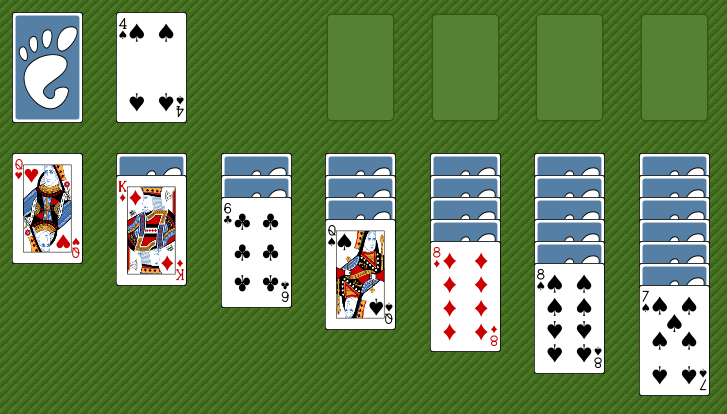

1. Solitaire Grande Game Overview
Solitaire Grande is a thoughtfully crafted Klondike solitaire implementation that earns its place in a crowded field by getting the fundamentals right and adding genuine value in the right places. A clean, responsive card interface. Real choices that matter — 1-card or 3-card draw. A coin-based achievement system that turns extended play into a personalized visual experience. And unlimited hints for players who want guidance without frustration.
The 1-card vs. 3-card draw choice is where Solitaire Grande first distinguishes itself from the default solitaire experience. One-card draw gives you full visibility into every stockpile card as it becomes available — maximum information, maximum control, highest natural win rate. Three-card draw restricts access to every third card and creates a more demanding, less forgiving game where the stockpile's hidden card ordering adds genuine uncertainty to your planning. Both modes use the same rules and the same deck — the draw style alone creates meaningfully different strategic experiences.
The achievement system provides an ongoing engagement structure that rewards players for specific accomplishments: completing games under time targets, achieving high win rates, winning consecutive games, and other measurable milestones. Achievements unlock coins that fund visual customization — card faces, card backs, and backgrounds spanning multiple visual themes. The personalization layer makes the game feel like yours rather than generic, and the achievement pursuit gives experienced players concrete goals to chase beyond any single game.
Unlimited hints lower the barrier to entry for new players without limiting the game for experienced ones — use them freely to learn, then challenge yourself to need them less.
Key Details:
| Genre: | Card Game / Solitaire |
| Difficulty Level: | Easy (1-card draw) to Medium (3-card draw) |
| Average Play Time: | 10–25 minutes per game |
| Best For: | Solitaire players who want a polished, personalized implementation with meaningful mode choice and an achievement progression system |
2. How to Play Solitaire Grande
Getting Started:
- Choose your draw mode: 1-card (one stockpile card revealed at a time) or 3-card (three cards dealt, only top card playable).
- Cards are dealt across 7 tableau columns in descending quantities, face-down cards beneath one face-up card per column.
- Drag and drop face-up tableau cards onto other cards that are one rank higher and the opposite color.
- When face-up cards are moved, face-down cards beneath them are revealed.
- Move Aces to the four foundation piles and build each suit from Ace to King to win.
Basic Controls:
- Drag & Drop: Click and hold a card, drag to destination, release to place.
- Draw Pile Click: Deal from the top deck when no tableau moves are available.
- Hint Button: Activates a suggestion for a valid available move (unlimited uses).
Objective: Build all four foundation piles from Ace to King in suit. Clear all 52 cards from the tableau and draw pile into the foundations to win.
3. Solitaire Grande Features & Highlights
- ✓ 1-card and 3-card draw modes — two meaningfully different strategic experiences in one game
- ✓ Achievement system — milestone rewards for specific accomplishments that earn coins for customization
- ✓ Full visual customization — card faces, card backs, and backgrounds across multiple themes
- ✓ Unlimited hints — guidance always available, making the game fully accessible to new players
- ✓ Clean drag-and-drop interface — responsive, intuitive card movement on both desktop and mobile
4. Solitaire Grande Tips & Strategies
Beginner Tips:
- Start with 1-card draw to learn the game. One-card draw provides maximum information and the highest chance of a solvable game. Use it to develop tableau management instincts before moving to the more demanding 3-card draw.
- Uncover face-down cards before everything else. Face-down cards are your most valuable unknowns. Prioritize every play that reveals a face-down card over plays that only reorganize already-visible cards.
- Use the hint button to learn, then try to anticipate hints. Use hints freely when starting out — not just to get unstuck but to see what moves the game considers worthwhile. Over time, try to identify the hinted move before it's revealed.
Advanced Strategies:
- In 3-card draw, track the cycle. When the stockpile is dealt in groups of three, specific cards appear only on specific cycles through the pile. Tracking roughly when important cards will appear allows you to plan tableau moves to be ready for them on the right cycle.
- Build long tableau sequences deliberately. In Solitaire Grande, you can move groups of cards as long as they maintain descending alternating-color order. Long sequences are powerful tools — they can be repositioned as a unit, uncovering multiple face-down cards in one move sequence.
- Use achievements as practice targets. The achievement system's specific challenges (complete a game in under a time threshold, win consecutive games) are excellent skill-building targets. Pursuing specific achievements develops focused habits that improve your overall solitaire performance.
What to Watch Out For:
- Empty column management. Empty tableau columns can only receive Kings. Clearing a column with no King ready to fill it creates an unused space that could otherwise be storing a useful sequence. Time column clears to coincide with available Kings.
- 3-card draw cycle exhaustion. In 3-card draw, the stockpile cycles through with cards available only every third pass. Running out of cycles while cards remain in the pile is a common ending condition — be strategic about when you cycle through rather than drawing continuously.
5. Solitaire Grande Game Elements Explained
The 1-Card vs. 3-Card Draw System: Solitaire Grande's choice between 1-card and 3-card draw is the game's most fundamental strategic decision. In 1-card draw, the stockpile reveals one card at a time in full sequence — you can see and access every card as it appears, giving you complete information and maximum flexibility. In 3-card draw, three cards are dealt simultaneously but only the top one is accessible — the other two are visible but unplayable until the top card is used, introducing a hidden-card element that significantly constrains your options and requires more forward planning to navigate effectively. Three-card draw also limits how many stockpile passes are available, adding a resource management dimension to the draw pile that doesn't exist in 1-card. The choice between modes is a difficulty selector as much as a preference one.
The Achievement and Coin System: Solitaire Grande's achievement system tracks specific performance milestones across your games — completing games under time targets, achieving consecutive wins, reaching high overall win rates, and other measurable accomplishments. Each achievement earned generates coins, which serve as the game's customization currency. The achievement framework transforms solitaire from a purely individual challenge into a structured progression system with explicit goals beyond any single game. For experienced players who have mastered basic completion, achievements provide the next layer of competitive challenge: optimizing toward specific metrics that the game has defined as meaningful accomplishments.
The Visual Customization System: Solitaire Grande's customization options cover three aesthetic dimensions: card face designs (the face-up visual style of the playing cards), card back designs (what you see when a card is face-down), and background themes (the playing environment behind the tableau). These options range across visual styles and themes, allowing players to create a personal aesthetic configuration that matches their preference. The customization isn't merely cosmetic in the sense of being trivial — card back designs affect how clearly you read face-down cards versus the tableau, and background choices affect the overall visual comfort of extended sessions. The coin-based unlock system ties personalization directly to achievement engagement, making the visual progression a reward for strategic skill development.
6. Solitaire Grande Frequently Asked Questions
Q: Which draw mode should I choose — 1-card or 3-card?
A: Start with 1-card draw if you're newer to solitaire or want a more relaxed experience. 1-card draw gives you full access to every stockpile card in sequence and produces higher natural win rates. Switch to 3-card draw when you want a greater challenge — it's significantly more demanding and rewards experienced players.
Q: How do I earn coins in Solitaire Grande?
A: Coins are earned by completing achievements — specific gameplay milestones like winning consecutive games, completing games within time targets, or reaching win rate thresholds. Check the achievements menu to see available targets and their coin rewards.
Q: Is there a limit to how many hints I can use?
A: No — Solitaire Grande offers unlimited hints. Use them as frequently as needed, especially when learning the game. There's no penalty for hint usage.
Q: Can I move multiple cards at once in the tableau?
A: Yes — groups of cards that form a valid descending alternating-color sequence can be moved together as a unit. Click the top card of the sequence you want to move and drag the group to a valid destination.
Q: What happens when I run out of moves and the draw pile is empty?
A: If no valid tableau moves exist and the draw pile is exhausted, the game cannot be completed in that deal. Start a new game. This outcome occurs in some deals regardless of how well you play — Klondike solitaire has a percentage of deals that are not completable from any starting sequence.