





1. Card Match 10 Game Overview
Card Match 10 is a clever hybrid card puzzle that fuses the best elements of solitaire, mahjong, and match-3 games into something genuinely fresh. The unifying concept is elegantly simple: clear the table by selecting cards that add up to 10. But the rules governing how those cards can be selected — same suit, descending order, specific sequences — turn that simple premise into a rich strategic puzzle that rewards both arithmetic thinking and careful planning.
The game occupies a satisfying middle ground between casual and challenging. The core mechanic (make cards sum to 10) is immediately accessible to anyone comfortable with basic addition, and the visual presentation — familiar playing cards on a clear table layout — removes any learning curve for the interface. But the selection rules, the storage frame system, and the multiple valid approaches to any given table state create genuine depth that keeps experienced puzzle players engaged.
Card Match 10 also blends its genre influences cleverly. The solitaire DNA shows in how cards are laid face-up and face-down, with buried cards inaccessible until those above them are cleared. The mahjong influence appears in the matching and removal mechanic. And the match-3 instinct shows up in the scramble for same-suit, sequenced groupings. If you've enjoyed any of these genres independently, Card Match 10 gives you all three at once.
Boosters, cosmetic unlocks, and an in-game economy add layers of engagement beyond the core puzzle, making Card Match 10 an easy recommendation for anyone who enjoys thoughtful, number-based card games.
Key Details:
| Genre: | Card Puzzle / Hybrid Solitaire |
| Difficulty Level: | Medium |
| Average Play Time: | 5–15 minutes per game |
| Best For: | Players who enjoy card games, number puzzles, and strategy games that combine logical arithmetic with spatial planning |
2. How to Play Card Match 10
Getting Started:
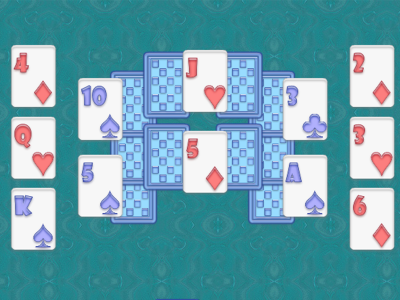
- Cards are dealt face-up and face-down across the table — only face-up, uncovered cards are available to select.
- Click cards of the same suit in descending order — they automatically merge into a single card showing their combined value.
- Select merged or individual cards that total exactly 10 to clear them from the table.
- Use the brown storage frame at the bottom to temporarily hold up to six cards while you plan.
- Clear all cards from the table to complete the level.
Basic Controls:
- Click to Select: Click any face-up, uncovered card to select it.
- Merge: Select same-suit cards in descending order — they combine automatically.
- Storage Frame: Click a card and then click the frame to store it temporarily; click a stored card to return it to play.
- Hammer Booster: Click the hammer icon, then click any card to remove it from the table.
- Extra Cells Booster: Expands the storage frame capacity for more temporary storage options.
Objective: Clear every card from the table by forming groups that add up to 10 (using same-suit, descending sequences) or straight sequences from 1 to 4. Use the storage frame and boosters strategically to overcome difficult layouts.
3. Card Match 10 Features & Highlights
- ✓ Unique hybrid of solitaire, mahjong, and match-3 — a genuinely novel card puzzle that blends three beloved genres
- ✓ Arithmetic-based matching — cards that sum to 10 clear, adding a number-puzzle dimension to traditional card games
- ✓ Storage frame system — six-card buffer gives you tactical flexibility when the table gets complicated
- ✓ Booster items — hammer and extra cells boosters provide strategic tools for difficult layouts
- ✓ Cosmetic progression — spend earned coins on new card designs, boxes, and backgrounds
4. Card Match 10 Tips & Strategies
Beginner Tips:
- Focus on uncovering face-down cards early. Cards buried under others are completely inaccessible. Prioritize clearing the top layers to open up your options — a board where all cards are visible is infinitely more manageable than one full of unknowns.
- Use the storage frame proactively, not reactively. Don't wait until you're stuck to use the frame. Park cards in storage when you spot a clearing opportunity that requires temporary removal, not just when you're out of other moves.
- Remember the straight sequence rule. Cards from 1 to 4 in sequence can be cleared as a straight — this is an alternative to the sum-to-10 rule and is extremely useful for managing low-value cards that are hard to work into 10-sum groupings.
Advanced Strategies:
- Plan your merges before your clears. Merging same-suit descending cards creates a new combined card — think ahead about what value that merged card will produce and whether it creates a useful 10-sum partner with something already on the table.
- Save the hammer booster for true dead ends. The hammer is powerful precisely because it removes any card unconditionally. Don't waste it on convenient shortcuts — save it for situations where a single blocking card has made the board unsolvable.
- Track your suit distribution. If you've used most of your hearts already and you have a merged hearts card in storage, be cautious — you may not have enough hearts remaining to make it part of another merge. Keep rough mental track of each suit's remaining count.
What to Watch Out For:
- Overfilling the storage frame. The frame holds a maximum of six cards. Storing cards without a clear plan for using them wastes frame slots and can leave you with a full frame and nowhere to park the next card you need to remove.
- Ignoring face-down cards until it's too late. A table where multiple buried columns still have face-down cards deep in their stacks becomes increasingly difficult to resolve as the available face-up selection shrinks. Uncover aggressively early.
5. Card Match 10 Game Elements Explained
The Sum-to-10 Clearing System: The central mechanic of Card Match 10 is selecting cards — individual or merged — that add up to exactly 10 to remove them from the table. Common pairings include 9+1, 8+2, 7+3, 6+4, and single 10-value cards (including merged cards that reach exactly 10). The arithmetic is always simple addition, but the strategic challenge lies in finding viable 10-sum combinations from what's currently face-up and uncovered, while managing the merge system to build cards of useful values. A key decision throughout each game is whether to merge small same-suit cards into a higher-value combined card (potentially a more useful 10-sum partner) or to use them individually in lower-value pairings. There's rarely a single right answer — optimal play adapts to the specific layout in front of you.
The Card Merge Mechanic: When you select two or more cards of the same suit in descending order, they automatically merge into a single card displaying their combined value. For example, selecting a 5 of hearts and a 4 of hearts (in descending order) creates a 9 of hearts. This merged card then participates in the sum-to-10 clearing system like any other card. The merge mechanic dramatically expands the combinatorial possibilities of each turn — you're not just working with the raw dealt cards but with composite values you can construct from them. Managing merge opportunities well (knowing when merging creates a useful composite vs. when it locks a suit into an inconvenient value) is one of the game's deeper strategic layers.
The Storage Frame System: The brown storage frame at the bottom of the screen holds up to six cards temporarily, acting as a buffer between the table and your planned moves. Cards in storage can be returned to active play at any time (when a valid destination exists) or kept there while you clear obstacles around them. The frame is the game's primary tactical flexibility tool — it lets you temporarily remove a blocking card to access what's underneath, hold a card of useful value until its ideal 10-sum partner becomes accessible, or simply park awkward cards while you resolve a more pressing area of the table. Using the frame proactively and purposefully (rather than just filling it when stuck) is what distinguishes strategic play from reactive play.
6. Card Match 10 Frequently Asked Questions
Q: How do I merge cards together?
A: Select cards of the same suit in descending numerical order — click the higher card first, then the lower one. They merge automatically into a single card showing their combined value.
Q: What should I do if I can't find any cards that add up to 10?
A: Check whether any same-suit descending pairs can be merged to create a card of a value you need. Also check the 1-to-4 straight sequence rule as an alternative clear path. If neither works, use the storage frame to rearrange access — or use the hammer booster on a blocking card.
Q: How do I access the cards that are face-down?
A: Face-down cards become accessible when all cards covering them are removed. Work top-to-bottom through each column to gradually uncover buried cards.
Q: What does the hammer booster do?
A: The hammer removes any single card from the table unconditionally — no matching or summing required. It's a powerful problem-solver for truly stuck situations. Use it sparingly, as it's a limited resource.
Q: How do I earn coins to buy new card designs and backgrounds?
A: Coins are earned by completing levels and achieving high-efficiency clears. Accumulated coins can be spent in the in-game shop on new card backs, box designs, and table backgrounds.