


1. UNO 3 Game Overview
UNO 3 is a card game built specifically around the number three: three players, three rounds, and a cumulative scoring system where the three-round total determines the winner. It's Uno with an ending — a defined structure that transforms the open-ended "keep playing until someone wins" format of standard Uno into a deliberate multi-round competitive event with meaningful score management.
The three-player lock is a design choice, not a limitation. Three players create a specific competitive dynamic that's distinct from two- or four-player Uno: you're managing relationships with two opponents simultaneously, there's no "team" dynamic, and the triangle of competition means every special card you play affects both opponents in some way (directly targeting one while potentially benefiting the other). Three-player Uno produces a different strategic texture than any other player count.
Three rounds add strategic depth that single-round Uno lacks. Winning one round is good; winning the overall three-round competition requires consistent performance — or a spectacular comeback in round three that overcomes a deficit from earlier rounds. The cumulative score system (the system adds up points across all three rounds at the end) means that a comfortable lead after two rounds can disappear if round three goes poorly. This scoring arc creates genuine strategic tension from the first card dealt through the final round's last play.
The Pass Button is UNO 3's most unusual mechanical addition: when you draw a card you don't want to play, you can press Pass to end your turn without playing the drawn card. This small flexibility changes the draw-pile dynamic meaningfully.
Key Details:
| Genre: | Card Game / Uno-style |
| Difficulty Level: | Easy to Medium |
| Average Play Time: | 20–35 minutes per full 3-round game |
| Best For: | Uno players who want a structured multi-round competitive format; great for players who enjoy the three-player card game dynamic |
2. How to Play UNO 3
Getting Started:
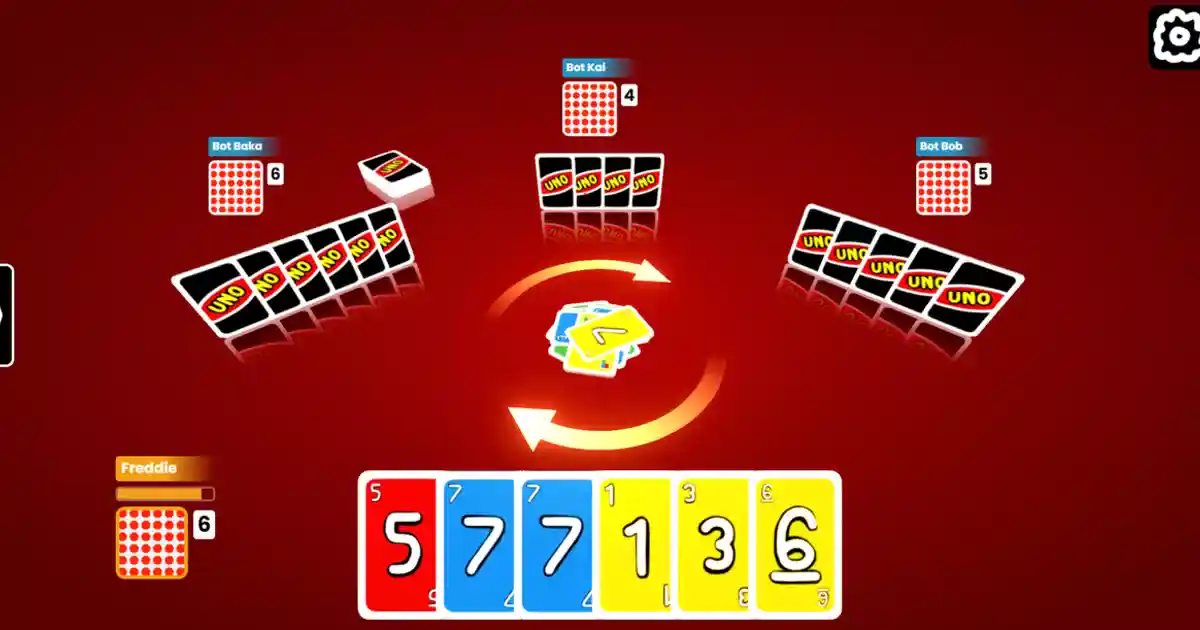
- Three players compete — no other player count is available.
- Each player receives cards; play proceeds with standard Uno color and number matching.
- Match cards by color, number, or symbol to the discard pile's top card.
- When you have one card remaining, press the UNO button immediately — failure results in drawing 2 penalty cards.
- The first player to empty their hand wins the round; three rounds are played, and the player with the highest cumulative score wins.
Basic Controls:
- Click / Tap Card: Play a valid matching card from your hand.
- Click / Tap Draw Pile: Draw when no valid play is available.
- UNO Button: Press immediately when you have exactly one card remaining.
- Pass Button: End your turn after drawing without playing the drawn card.
Objective: Win as many rounds as possible over three rounds to accumulate the highest total score. The player with the highest score after all three rounds wins UNO 3.
3. UNO 3 Features & Highlights
- ✓ Three-round cumulative scoring — a structured multi-round format where the overall winner is determined by three-round total
- ✓ Fixed three-player competition — a specific player count that creates a distinct three-way competitive dynamic
- ✓ Pass Button mechanic — option to end a turn after drawing without playing the drawn card
- ✓ UNO button timing pressure — mandatory button press with penalty for missed timing
- ✓ Multi-round comeback potential — falling behind in early rounds doesn't eliminate overall victory possibility
4. UNO 3 Tips & Strategies
Beginner Tips:
- Think of each round as building toward the three-round total, not as a standalone win. Winning round 1 gives you a score lead, but rounds 2 and 3 can swing the competition significantly. Play each round to maximize score accumulation, not just to win that round faster.
- Use the Pass Button when the drawn card creates no strategic value. If you draw a card that doesn't match the discard and doesn't give you a useful special card for later, passing ends your turn without adding to your hand. However, be cautious — keeping a card (even an unplayable one) gives you future flexibility.
- Press the UNO button the instant you play your second-to-last card. Three-player Uno has two opponents who can potentially call your missed UNO. The penalty of 2 cards at a crucial near-win moment can reverse your position quickly. Make the UNO button press reflexive.
Advanced Strategies:
- In three-player matches, target whoever is ahead in cumulative score. If one opponent won round 1 convincingly, they're your primary opponent in rounds 2 and 3. Direct special cards (Skip, Reverse, Draw Two) toward the cumulative leader rather than spreading disruption equally.
- Build score cushions in winnable rounds. Uno scoring gives you points based on cards remaining in opponents' hands when you win. Winning a round where opponents hold high-value cards (picture cards, Wilds) earns more than winning when they've nearly emptied. When you're close to winning a round and can sustain the position slightly longer, consider whether more score is accessible.
- Track the three-round score trajectory. After each round, note where each player stands in the cumulative total. A player 30 points behind after round 2 with one round remaining needs to win that round decisively. A player 30 points ahead can play more conservatively in round 3 and still win overall.
What to Watch Out For:
- Round 3 comebacks. A two-round lead doesn't guarantee the overall win — a round 3 where the trailing player wins decisively and your opponents still hold high-value cards can flip the cumulative score. Maintain competitive play in round 3 even with a comfortable lead.
- Pass Button over-reliance. Passing after drawing is sometimes right, but habitual passing builds a hand of many cards over time — each pass adds a drawn card to your hand without removing one. Monitor hand size when using the Pass Button regularly.
5. UNO 3 Game Elements Explained
The Three-Round Cumulative Scoring System: UNO 3's fundamental structural innovation is its multi-round format. Rather than a single game where the first player to empty their hand wins the full match, UNO 3 is played over exactly three rounds. Each round produces a score based on the cards remaining in opponents' hands — higher-value cards (Wilds, picture cards, high numbers) contribute more points to the winner's score. These scores accumulate across all three rounds, and the player with the highest cumulative total at the end of round three wins the overall match. This system creates strategic considerations beyond any individual round: a player who wins round 1 convincingly but plays poorly in rounds 2 and 3 can lose the overall match to a player who consistently accumulated moderate scores across all three rounds.
The Three-Player Dynamic: UNO 3's fixed three-player format is a deliberate design choice that creates a specific competitive geometry. In two-player Uno, every card is targeted at your one opponent directly. In four-player Uno, special cards distribute impact across three opponents and the competitive web is complex. Three-player Uno creates a triangle: any special card targets one of two opponents, and every targeting decision implicitly affects the relationship with the third player (who benefits from you disrupting their shared opponent). Managing this triangle — when to team up implicitly against the cumulative leader, when to play individually — is a three-player-specific strategic dimension that requires different thinking than two- or four-player formats.
The Pass Button Mechanic: UNO 3's Pass Button allows a player who has drawn a card to end their turn without playing the drawn card. This option is unavailable in standard Uno, where a drawn card is either played immediately (if valid) or added to your hand. The Pass Button gives players more control over their hand composition — you can choose not to play a drawn card that doesn't serve your current strategy, accepting a larger hand in exchange for strategic flexibility on future turns. The Pass Button is particularly valuable when the drawn card is misaligned with your color strategy or when a drawn Wild would be more valuable held for a future declaration than played immediately on a card you could have matched anyway.
6. UNO 3 Frequently Asked Questions
Q: Why is it called UNO 3 when it's just standard Uno rules?
A: The "3" refers to the game's three defining characteristics: exactly 3 players, exactly 3 rounds of play, and a cumulative score system where the 3-round total determines the winner.
Q: Can I choose to play with more or fewer than 3 players?
A: No — UNO 3 is fixed at exactly three players. The three-player configuration is central to the game's competitive design.
Q: What does the Pass Button do?
A: After drawing a card from the draw pile, the Pass Button lets you end your turn without playing the drawn card. The card is added to your hand, but you don't have to play it. This is different from standard Uno where a drawn valid card can be immediately played or kept.
Q: How is the winner determined after three rounds?
A: After all three rounds are complete, the system totals each player's score from all three rounds. The player with the highest cumulative total wins. If you won rounds 1 and 3 but scored 0 in round 2, your total competes against opponents' totals from all three rounds.
Q: What happens if I forget to press the UNO button?
A: You receive 2 penalty cards, which are added to your hand. In a three-player match where both opponents can potentially call your missed UNO, the timing pressure is real — press the button the moment you play your second-to-last card.