



1. Spider Solitaire 2 Suits Game Overview
Spider Solitaire 2 Suits is the intermediate challenge in the Spider Solitaire family — a step up from single-suit accessibility and a step below the full four-suit marathon. With red and black cards both in play across 104 cards and 10 columns, it delivers the authentic Spider experience: building King-to-Ace sequences in the same suit across a crowded tableau, clearing completed sequences off the board, and managing the increasing complexity that two suit groups create.
The fundamental difference between 2 Suits and 1 Suit is that mixed-suit sequences — moving a red card on top of a black one regardless of suit — are allowed but don't complete to the foundation. Only runs of 13 identical-suit cards from King down to Ace clear the board. This means you can build temporary mixed-color sequences as staging tools, but eventually every card needs to be in a proper same-suit sequence to score. Managing mixed sequences as useful temporary constructions versus recognizing when they're becoming permanent obstacles is the key skill that 2 Suits demands.
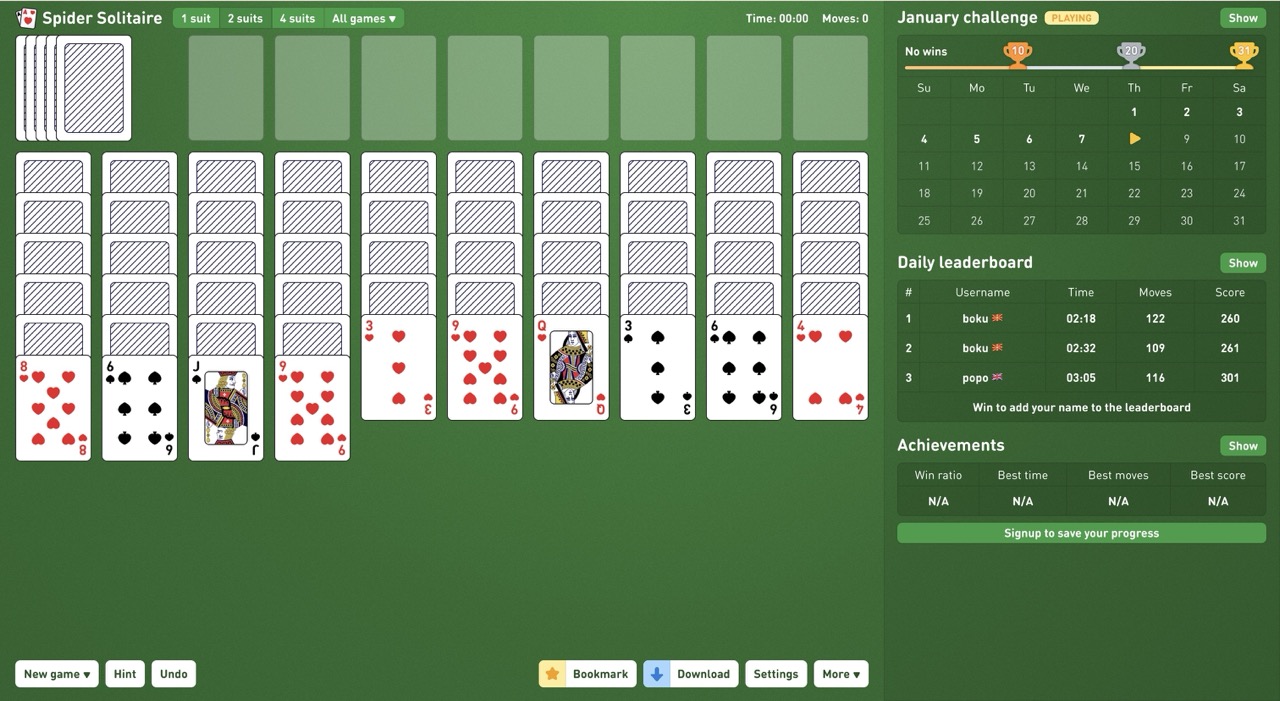
The reserve cards in the upper left serve as the spare pile — clicking "New Card" distributes one card to each of the 10 columns when no valid moves exist. This can rescue a stuck tableau but also adds complexity by burying existing partial sequences under new cards. Timing these deals wisely is as important as the move sequences themselves.
Key Details:
| Genre: | Card Game / Solitaire |
| Difficulty Level: | Hard |
| Average Play Time: | 20–45 minutes per game |
| Best For: | Spider Solitaire players who have mastered 1-suit and want the next challenge; experienced solitaire players seeking increased strategic complexity |
2. How to Play Spider Solitaire 2 Suits
Getting Started:
- 104 cards are dealt across 10 tableau columns — face-down cards beneath one face-up card per column.
- Move face-up cards onto other face-up cards one rank higher — mixed suits are valid for movement.
- When a complete King-to-Ace same-suit sequence forms in any column, it's automatically removed.
- When no valid moves exist, click "New Card" to deal one card to each column from the reserve.
- Clear all cards by completing all eight King-to-Ace same-suit sequences to win.
Basic Controls:
- Click to Select: Click a face-up card to select it.
- Click Destination: Click a valid destination to move the card or sequence.
- "New Card" Button: Deal one card to each column from the reserve pile.
Objective: Complete all eight King-to-Ace sequences in the same suit to clear the 104-card double deck. Mixed-suit sequences allow movement but don't count as completions — only same-suit runs of 13 cards clear the board.
3. Spider Solitaire 2 Suits Features & Highlights
- ✓ Two-suit complexity — red and black cards together create cross-suit dependencies that single-suit play doesn't require
- ✓ Mixed-suit movement allowed — any rank-descending sequence can be moved, but only same-suit sequences clear
- ✓ 104-card double deck — twice the cards of Klondike for extended, complex strategic games
- ✓ Ten-column tableau — wider board than Klondike, creating more spatial complexity to manage
- ✓ Reserve dealing mechanic — timed "New Card" deals that can rescue stuck boards at the cost of additional complexity
4. Spider Solitaire 2 Suits Tips & Strategies
Beginner Tips:
- Always prefer same-suit moves over mixed-suit moves when both are available. Same-suit sequences are directly useful for foundation completion. Mixed-suit sequences require future disassembly. Every opportunity to maintain suit integrity is worth taking.
- Build toward one suit sequence at a time. Rather than trying to organize all four suits simultaneously, focus your tableau management on completing one King-to-Ace same-suit run first. A cleared sequence significantly reduces board complexity.
- Delay "New Card" deals as long as possible. New cards add complexity to the tableau and can bury partial sequences under new ones. Exhaust every possible tableau move before dealing, including cross-column moves that may not seem obviously useful.
Advanced Strategies:
- Use mixed-suit sequences as temporary staging. A mixed-suit sequence occupying a column isn't wasted — it's a structured staging area that can be partially disassembled to extract same-suit sub-sequences when needed. Think of mixed sequences as "parked" cards rather than failed ones.
- Create and protect empty columns. An empty column in 2-suit Spider is extraordinarily powerful — it can receive any card or sequence temporarily for complex reorganization. Deliberately clearing a column and keeping it empty through the next several moves provides maximum rearrangement flexibility.
- Track both suit groups across the tableau. With red and black in play, mentally track where each suit's cards are distributed. A high concentration of, say, heart cards in one area of the tableau is an opportunity to build that suit's sequence before those cards get buried.
What to Watch Out For:
- Long mixed-suit sequences that lock the tableau. A 7-card mixed-suit sequence occupying a full column is nearly impossible to disassemble into useful same-suit components without multiple empty columns as staging. Prevent these from forming by maintaining suit awareness in your move choices.
- New Card timing disasters. Dealing "New Card" on a tableau where you have nearly-complete same-suit sequences can bury the final needed cards under new ones. Before dealing, confirm that the deal won't disrupt a sequence that's one or two cards from completion.
5. Spider Solitaire 2 Suits Game Elements Explained
The Two-Suit Movement System: Spider Solitaire 2 Suits uses two suits (one red, one black) across the 104-card double deck, creating a movement system with an important distinction: any sequence of cards in descending rank can be moved together, regardless of suit consistency. A red 9, black 8, red 7 sequence can be moved as a unit to any black 10. This mixed-suit movement flexibility is a tactical tool — it allows reorganization that same-suit-only movement couldn't achieve. But mixed sequences can only be completed as foundations when broken down and reorganized into same-suit runs of 13. Players who treat mixed-suit movement as an end goal (building the longest mixed sequence possible) struggle; players who treat it as a staging tool (using it to position cards for future same-suit consolidation) succeed.
The Reserve Dealing System: When no valid tableau moves exist, Spider Solitaire 2 Suits allows dealing from the reserve — distributing one card to each of the 10 columns simultaneously. This deal is both rescue and risk. It rescues by providing new cards that may create fresh move opportunities. It risks by adding cards to every column, potentially burying partial sequences or filling nearly-empty columns. The timing of a deal is a strategic decision: dealing too early wastes the rescue mechanism on a situation the current tableau could have resolved; dealing at the right moment unlocks multiple columns simultaneously. The reserve has limited deals (determined by the total card count minus the initial deal), so each use is a resource expenditure.
The Complete Sequence System: Spider Solitaire 2 Suits' win condition requires eight complete King-to-Ace sequences of the same suit — two sequences per suit (hearts, diamonds, clubs, spades) across the two decks. When a complete 13-card same-suit sequence forms anywhere in the tableau, it's automatically removed to one of the eight foundation slots. This removal is the primary form of board progress: each completed sequence is a permanent board simplification that makes subsequent organizing easier. Building these complete sequences — through a combination of same-suit moves and careful disassembly of mixed-suit staging sequences — is the entire strategic goal of the game.
6. Spider Solitaire 2 Suits Frequently Asked Questions
Q: Can I move a sequence of mixed-suit cards?
A: Yes — any sequence of cards in descending rank order can be moved as a unit, regardless of whether the suits match within the sequence. However, mixed-suit sequences cannot be sent to the foundations. Only same-suit sequences of 13 consecutive cards (King through Ace) automatically clear.
Q: When should I click "New Card"?
A: When you've exhausted all possible tableau moves — including cross-column moves that may not have seemed immediately useful. New cards add complexity, so deal only when genuinely stuck. Before dealing, verify no partial sequences close to completion will be buried by the incoming cards.
Q: Is 2 Suits significantly harder than 1 Suit?
A: Yes — the introduction of a second suit group creates cross-suit dependencies that single-suit play doesn't have. Mixed sequences that would be complete runs in 1-suit mode must be carefully managed in 2-suit mode. Expect a meaningful difficulty jump.
Q: What's the difference between this and 4-suit Spider?
A: 2 Suits uses only red and black cards (two suits), while 4-suit uses all four suits. 4-suit Spider is dramatically more difficult because same-suit sequence building must be maintained across four distinct groups rather than two.
Q: How many times can I deal "New Card"?
A: The number of deals depends on how many reserve cards remain after the initial deal — typically five or six deal rounds for a standard 104-card game. Each deal distributes ten new cards (one per column), so track how many deals remain as the reserve empties.