


1. Duo Cards Game Overview
DUO Cards is a sharp, competitive turn-based card game that pits you against a roster of challenging CPU opponents, each with their own distinct playing style and strategic tendencies. If you love the color-and-number matching gameplay of Uno-style card games but want a focused single-player experience that pushes your tactical thinking, DUO Cards delivers exactly that.
The core mechanic will feel immediately familiar: match the color or number of the card on the discard pile to play your own. But DUO Cards layers strategic tension on top of that familiar foundation with its announcement mechanic — when you're down to two cards, you must announce it before playing. Get it right and you're one turn from victory. Fail to announce it and you're drawing penalty cards that could completely reverse your advantage. That rule transforms late-game moments into genuine high-stakes decisions rather than simple card-counting exercises.
What gives DUO Cards real staying power is its CPU opponent design. These aren't pushover AI players — they're distinct characters with genuinely different strategies that force you to adapt your approach from match to match. Some play aggressively, burning through special cards early. Others are conservative, holding disruption cards for critical moments. Learning each opponent's tendencies and exploiting them is the meta-game that keeps DUO Cards engaging well beyond the first few wins.
For players who want a focused, strategic card game experience without needing other live players, DUO Cards is an excellent choice.
Key Details:
| Genre: | Card Game / Turn-Based Strategy |
| Difficulty Level: | Medium to Hard |
| Average Play Time: | 10–20 minutes per match |
| Best For: | Solo card game players who enjoy strategic matching games against challenging, personality-driven CPU opponents |
2. How to Play Duo Cards
Getting Started:
- A card is placed face-up on the discard pile to start each round.
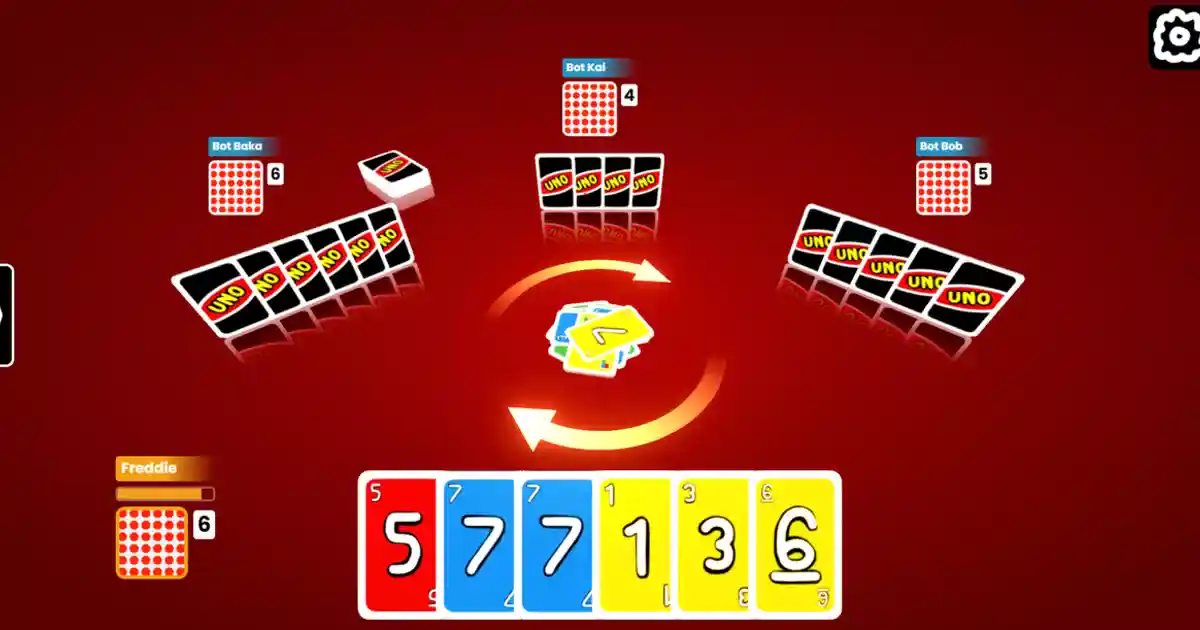
- On your turn, play a card from your hand that matches the discard pile's current color or number/symbol.
- If you have no matching card, draw from the deck until you find one.
- Use special cards strategically to disrupt your opponent's hand and accelerate your own card shedding.
- When you have exactly two cards left, announce it before playing — then play your penultimate card to advance to one card remaining.
Basic Controls:
- Click / Tap to Play: Click or tap a valid card in your hand to play it to the discard pile.
- Click / Tap Deck: Click or tap the draw pile to take a card when no valid play is available.
- Announcement: Trigger the announcement action when you have two cards remaining — timing is critical.
Objective: Be the first player to discard all cards in your hand. When you reach two cards, announce it correctly before playing to set up your winning move. Successfully discard your final card on the turn after the announcement to win the round.
3. Duo Cards Features & Highlights
- ✓ Unique two-card announcement mechanic — adds a high-stakes declaration layer that transforms late-game moments
- ✓ Competitive CPU opponents — each opponent has distinct strategic tendencies that demand adaptive play
- ✓ Penalty system for missed announcements — failed declarations result in drawing additional cards, keeping every endgame tense
- ✓ Touch and mouse controls — fully accessible on both desktop and mobile devices
- ✓ Replayable strategic depth — opponent variety ensures no two matches play identically
4. Duo Cards Tips & Strategies
Beginner Tips:
- Always watch your card count. The announcement rule only applies when you reach two cards — getting there without realizing it and missing the announcement window is the most common beginner mistake that costs rounds.
- Don't hold special cards forever. New players often hoard disruptive cards waiting for the "perfect" moment. Use them when they create a meaningful advantage — not at the last possible second when their impact is reduced.
- Match by color when possible over number. Color matching gives you more flexibility for subsequent turns since your hand likely contains more cards of any given color than any given number.
Advanced Strategies:
- Bait the announcement. If your opponent is close to two cards, play cards that force them to draw — interrupting their path to the announcement and resetting their momentum while protecting your own countdown.
- Study each CPU's patterns. Different CPU opponents prioritize different strategies. Identify whether your current opponent is aggressive (burns special cards fast) or conservative (holds them for critical moments), then adjust your play to either avoid their traps or exploit their predictability.
- Control the discard pile color. If your hand is heavy in one color, use color-changing cards to redirect the pile to that color, making several of your cards immediately playable and accelerating your hand reduction.
What to Watch Out For:
- The announcement penalty. If you have two cards and play one without announcing first, you'll draw penalty cards that can dramatically extend your round. Build the habit of checking your card count before every play in the late game.
- CPU players exploiting your announcement. Skilled CPU opponents will use disruption cards the moment you announce — drawing cards, skipping your turn, or changing the color to something you don't hold. Have a backup plan before announcing.
5. Duo Cards Game Elements Explained
The Announcement Mechanic: The defining feature that separates DUO Cards from standard Uno-style games is its two-card announcement requirement. When your hand is reduced to exactly two cards, you must announce this fact — verbally or through the game's interface — before playing your next card. If you successfully announce with two cards and then play one of them on your following turn, you're left with one card and are one valid play from winning the round. If you fail to announce when required (playing your third-to-last card and leaving yourself at two without announcing), you receive a penalty and must draw additional cards. This mechanic creates a consistent late-game tension point where both you and your opponents are watching card counts carefully and timing actions deliberately.
The CPU Opponent System: DUO Cards features multiple CPU characters as opponents, each programmed with distinct playing strategies that make them genuinely different adversaries. Rather than a single "smart AI" that plays the same way every time, each character has personality-driven tendencies: some hoard color-change cards until they've backed you into a corner; others play aggressively and burn their hand down fast, caring less about card efficiency and more about speed. Learning to identify which style you're facing — and adapting your strategy accordingly — is what gives DUO Cards its replay depth. A strategy that works against a conservative CPU character can fail completely against an aggressive one.
The Special Card System: Like all Uno-style card games, DUO Cards includes special action cards that provide tools beyond basic color and number matching. These cards — which typically include skip turns, force drawing, reverse order, and color changes — are the game's primary disruption mechanisms. Managing your special cards well means more than just playing them when valid: it means holding the right ones for the right moments, using them to break opponent momentum at critical points (like just after they've announced), and not wasting high-value special cards on situations that could be resolved with basic matching.
6. Duo Cards Frequently Asked Questions
Q: When exactly do I need to make the announcement?
A: You must announce when you have exactly two cards remaining, specifically before you play one of them. The announcement should happen at the start of the turn when you have two cards — not after you've played down to two from a larger hand.
Q: What happens if I forget to announce?
A: You receive a penalty — typically drawing additional cards from the deck. This is one of the most impactful mistakes in DUO Cards since it can reverse a winning position back into a competitive hand. Build the habit of checking your count before every late-game play.
Q: How do I beat the harder CPU opponents?
A: Study their patterns over several matches. Harder CPU characters make more deliberate special card plays and are better at timing disruptions against your announcements. Countering them requires both watching your own card count and actively tracking theirs to anticipate when they'll play disruption cards.
Q: Is DUO Cards compatible with mobile devices?
A: Yes — the game supports both touch and mouse controls and works in mobile browsers without requiring a download.
Q: How many rounds does a full match consist of?
A: Match length varies by version — some DUO Cards implementations run as single-round competitions while others track wins across multiple rounds. Check your specific version for the full match structure.