


1. Spider Solitaire Game Overview
Spider Solitaire is the game that solitaire players graduate to when Klondike starts feeling comfortable — a more complex, more demanding, and ultimately more rewarding card experience that scales from accessible single-suit challenge to a genuinely formidable four-suit marathon that tests even experienced card players.
The fundamental premise is the same beloved solitaire framework: organize cards into complete sequences and send them to the foundations. But Spider uses two full 104-card decks, and the difficulty spectrum across its three suit variants spans an enormous range. One-suit Spider (all black cards) is learnable in a few sessions. Two-suit Spider (red and black) introduces significant complexity through cross-color constraints. Four-suit Spider (all four suits) is one of the hardest widely-played solitaire variants — demanding sustained strategic planning across a crowded, complex board where a single suboptimal sequence of moves can create unsolvable blockades many turns later.
The complete sequence rule — filling an entire suit from King down to Ace in the same suit before it's removed to the foundations — creates a high-stakes moment unlike anything in Klondike. Completing a sequence in Spider requires assembling thirteen consecutive same-suit cards in order, which is a sustained achievement that rewards careful column management and patience.
The Random difficulty mode adds a wildcard dimension: unpredictable difficulty combinations keep experienced players constantly adapting rather than applying a rehearsed strategy.
Key Details:
| Genre: | Card Game / Solitaire |
| Difficulty Level: | Easy (1 suit) to Very Hard (4 suits) |
| Average Play Time: | 15–45 minutes per game |
| Best For: | Solitaire enthusiasts who want a significantly more challenging experience than Klondike; experienced card players seeking genuine strategic depth |
2. How to Play Spider Solitaire
Getting Started:
- Choose your game type (1 suit, 2 suits, or 4 suits) and difficulty (Easy, Medium, Hard, or Random).
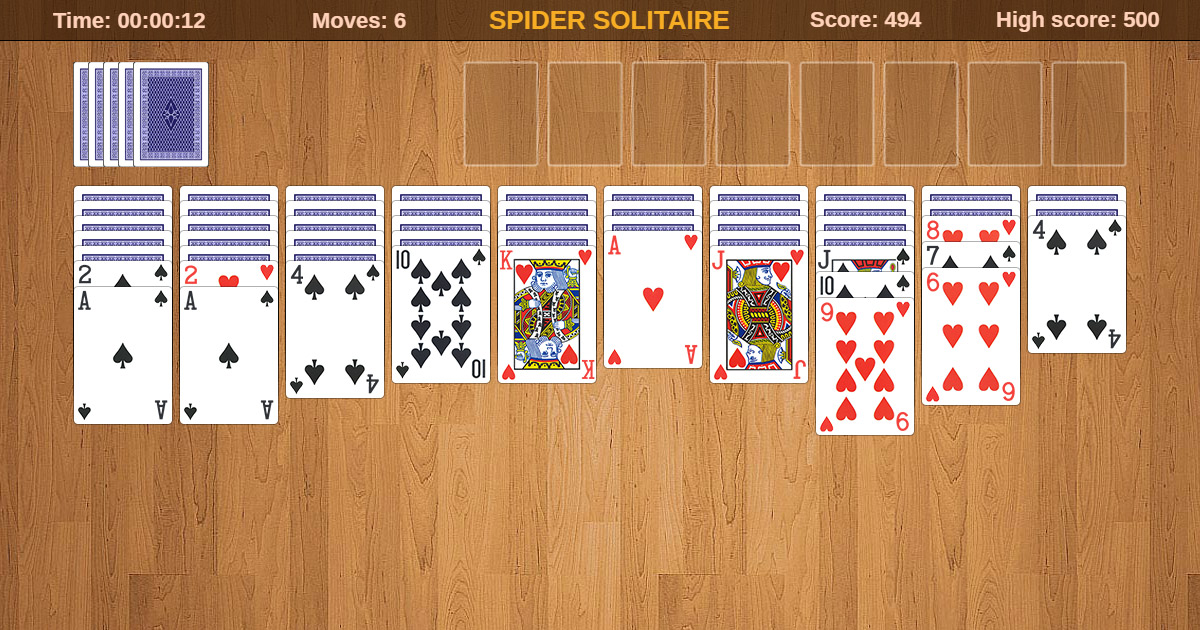
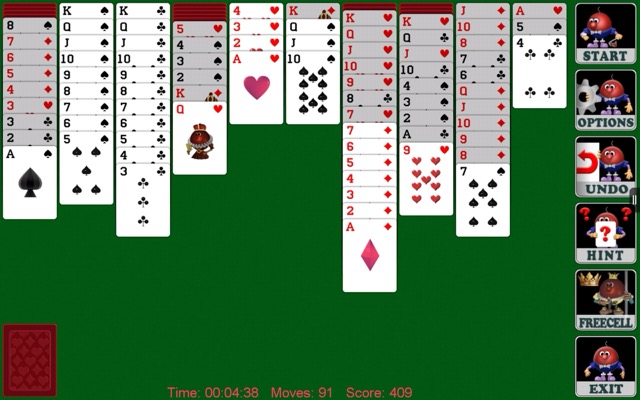
- Cards are dealt face-down and face-up across 10 tableau columns (more columns than Klondike).
- Move face-up tableau cards onto other face-up cards one rank higher — suits don't need to match for movement, but matching suits builds more efficiently.
- When a complete sequence of 13 same-suit cards (King through Ace) forms in a column, it's automatically removed to the foundations.
- When no moves exist, deal a new row of cards from the spare pile (one card per column).
Basic Controls:
- Click to Select: Click a face-up card to select it.
- Click Destination: Click a valid destination card to move the selected card or sequence.
- Spare Pile Click: Deal a new row of cards when no tableau moves remain.
Suit Mode Summary:
- 1 Suit: All black cards — sequence-building within a single color
- 2 Suits: Red and black — cross-color sequence management
- 4 Suits: All four suits — the most complex, demanding full suit-sequence integrity
Objective: Clear all 104 cards to the eight foundation piles by forming complete King-to-Ace sequences in the same suit across the 10-column tableau.
3. Spider Solitaire Features & Highlights
- ✓ Three suit variants — 1, 2, and 4 suit options that create three meaningfully different difficulty experiences
- ✓ Four difficulty modes — Easy, Medium, Hard, and Random for further calibration
- ✓ Ten-column tableau — wider than Klondike's seven columns, creating more complex spatial management
- ✓ 104-card double deck — twice the cards of standard solitaire for extended, more complex games
- ✓ Random mode — unpredictable difficulty combinations that prevent strategic complacency
4. Spider Solitaire Tips & Strategies
Beginner Tips:
- Start with 1-suit mode. Single-suit Spider removes cross-color complexity and lets you focus entirely on sequence building and column management. Master the 1-suit experience before advancing to 2 or 4 suits.
- Move same-suit cards together when possible. Even in 2 and 4 suit modes where mixed-suit movement is allowed, prioritize building same-suit sequences. Mixed sequences must be disassembled before completing a foundation removal — same-suit sequences are already ready.
- Keep columns flexible — avoid filling them completely. Completely filled columns in Spider lose flexibility. Leave some columns with open space that can receive and temporarily store sequences while you reorganize elsewhere.
Advanced Strategies:
- In 4-suit mode, identify your "lead suit" early. With four suits to manage simultaneously, focus on whichever suit has the most complete sequence potential from the current deal and prioritize building it to foundation completion first. Getting one suit off the board significantly reduces subsequent complexity.
- Use spare pile deals strategically, not as last resorts. The spare pile deals one card to each column — choosing the right moment to trigger this can simultaneously open useful moves across multiple columns. Don't wait until completely stuck; deal early if the timing would unlock important sequences.
- Plan column emptying deliberately. Empty columns in Spider are powerful staging areas — they can receive any card or sequence. Creating and using empty columns deliberately (not accidentally) provides the flexibility needed for complex sequence reorganization in 4-suit mode.
What to Watch Out For:
- Mixed-suit sequence traps. Moving a mixed-suit sequence (which is allowed) seems convenient, but mixed sequences must eventually be split apart to complete individual suit foundations. Mixed sequences lock up column space with cards that can't be sent to foundations without first disassembling the mixed portion.
- Spare pile depletion without board progress. If you're dealing from the spare pile repeatedly without making meaningful sequence progress, the board is trending toward an unsolvable state. Stop and evaluate whether a different reorganization approach exists before the spare pile exhausts.
5. Spider Solitaire Game Elements Explained
The Three Suit Variant System: Spider Solitaire's three suit modes create three categorically different games. One-suit mode uses only black cards — all sequences are single-color, movement is unrestricted by suit considerations, and the challenge is purely sequence organization without suit complexity. Two-suit mode introduces red and black cards together, requiring players to track two color groups simultaneously and creating cross-color dependencies that significantly increase the strategic complexity. Four-suit mode uses all four suits across the full 104-card double deck, requiring same-suit sequence building for foundation removal while allowing mixed-suit tableau movement — creating a situation where every move must be evaluated for its impact on multiple concurrent suit sequences. Each variant is a distinct game; mastery in one does not directly transfer to the next.
The Complete Sequence Rule: Spider's win condition requires forming complete sequences — all 13 cards of the same suit from King down through Ace in the same column. When such a sequence forms anywhere in the tableau, it's automatically removed to one of the eight foundation piles. This removal is the primary game action that makes progress tangible; clearing a complete sequence is a significant achievement in any suit mode. In 4-suit mode, forming a complete sequence requires that all 13 cards of a specific suit appear in a single column in exact descending order — a sustained organizational achievement that can require dozens of preparatory moves before the final sequence can be assembled.
The Spare Pile System: When no valid moves remain on the 10-column tableau, players can deal from the spare pile — dealing one card face-up to each column simultaneously. This spare deal replenishes accessible cards but also occupies column space, potentially complicating existing partial sequences. The spare pile contains multiple rows of dealing (the exact number depends on the total cards minus the initial deal), and each deal is a strategic moment: dealing too early may bury useful cards; dealing at the right moment can unlock multiple new sequence opportunities simultaneously. When the spare pile is exhausted with cards still in the tableau, the game ends without a win.
6. Spider Solitaire Frequently Asked Questions
Q: What's the difference between 1 suit, 2 suits, and 4 suits?
A: 1-suit uses only black cards, making all sequences single-color and the game most accessible. 2-suits uses red and black, introducing cross-color complexity. 4-suits uses all four suits across the full deck, requiring same-suit sequences for foundation removal — the hardest mode by a significant margin.
Q: Can I move mixed-suit sequences?
A: Yes — you can move any sequence of cards in descending rank order, regardless of suit consistency. However, mixed-suit sequences cannot be sent to the foundation piles. Only complete same-suit King-to-Ace sequences remove to foundations.
Q: When should I deal from the spare pile?
A: Deal when no tableau moves are available OR when the timing would simultaneously unlock multiple useful moves across several columns. Avoid dealing as a panic response when other moves seem available but difficult.
Q: What does Random difficulty mode do?
A: Random mode assigns a random difficulty from Easy, Medium, and Hard for each game. This prevents strategy from becoming formulaic and keeps experienced players adapting to new challenge levels unpredictably.
Q: Is Spider Solitaire significantly harder than Klondike?
A: Yes — Spider Solitaire is meaningfully more demanding than Klondike, particularly in 2-suit and 4-suit modes. The double deck, ten columns, and same-suit sequence requirement create a more complex strategic environment. Start with 1-suit Spider if transitioning from Klondike to build Spider-specific skills gradually.