





1. Suika Game Game Overview
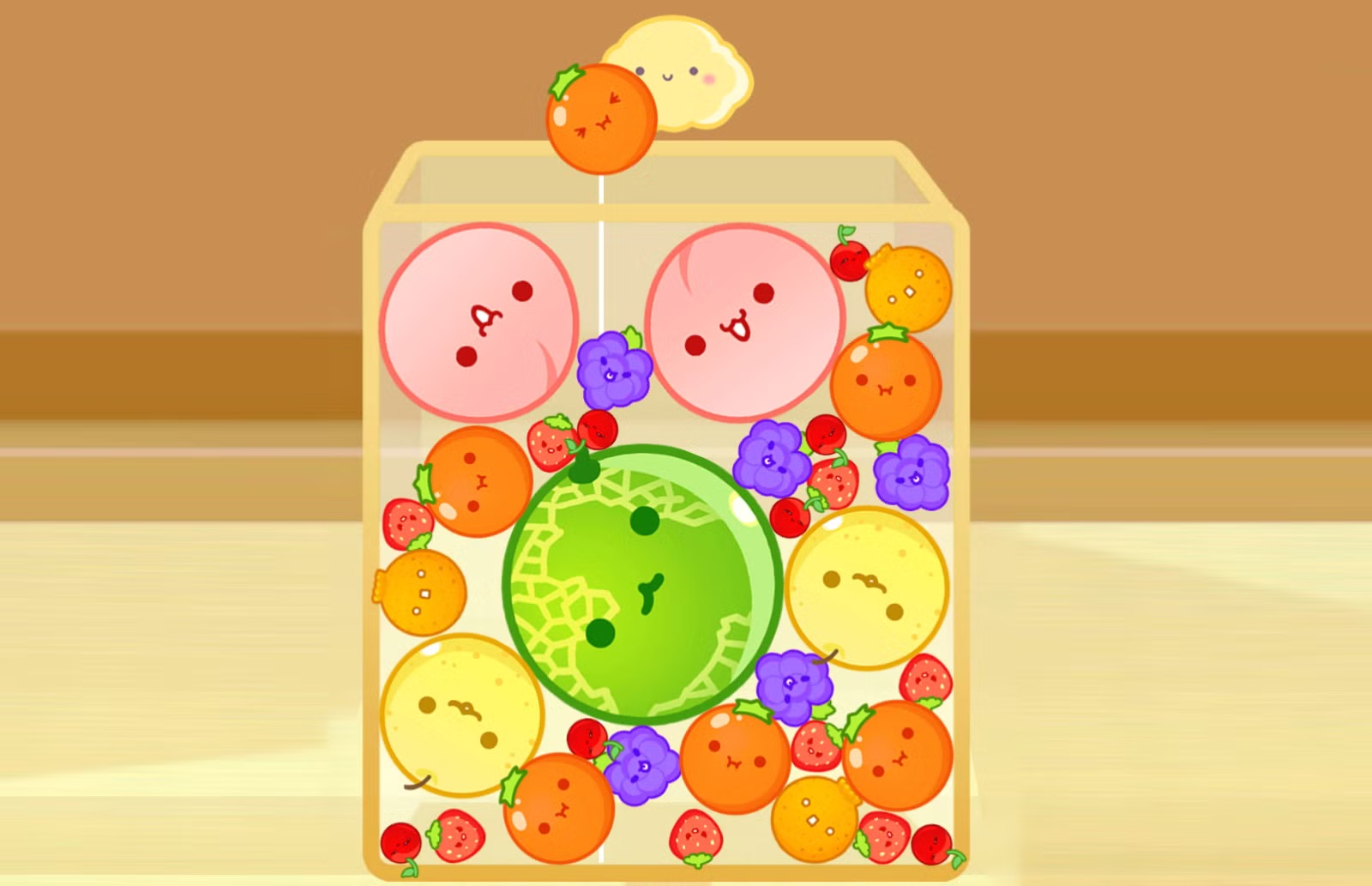
Suika Game is the fruit-dropping, fruit-merging puzzle sensation that took the casual gaming world by storm — a game that looks deceptively simple and plays with an addictive elegance that keeps you dropping cherries and chasing watermelons for session after session. The premise is clean: drop fruits into a box, merge matching fruits into larger ones, and try to keep everything from overflowing before the box runs out of space.
The merging chain is the game's core delight. Two cherries become a strawberry. Two strawberries become a grape. Two grapes become a dekupon. Two dekupons become an orange, and so on up through nine stages to the final form — the watermelon. Each merge creates a larger fruit that takes up more space, which creates the game's central tension: every merge is a short-term success and a long-term space management problem. The goal isn't just to merge — it's to merge efficiently enough that the box stays manageable.
The cascade effect is what creates Suika Game's most memorable moments. A well-positioned merge can trigger a chain reaction — the new larger fruit rolls into matching neighbors, which merge into an even larger fruit, which triggers another merge — and suddenly a stack of crowded small fruits has been elegantly resolved into one or two large ones. Planning for cascade potential is the advanced skill the game rewards.
The weekly global leaderboard creates a comparative context for high-score chasing. Currently the highest recorded score sits at 3,900 — a number to aspire toward.
Key Details:
| Genre: | Puzzle / Merge / Arcade |
| Difficulty Level: | Easy to Hard (escalates with fruit accumulation) |
| Average Play Time: | 5–20 minutes per session |
| Best For: | Casual puzzle fans who love satisfying merge mechanics; great for score-chasing and watermelon milestone pursuit |
2. How to Play Suika Game
Getting Started:
- A fruit appears at the top of the screen — position it horizontally over the box.
- Drop the fruit by clicking or releasing it — it falls into the box and comes to rest.
- When two identical fruits touch, they automatically merge into the next size fruit.
- Continue dropping and positioning fruits to trigger merges and keep the box from filling.
- The game ends when any fruit overflows above the box's rim.
Basic Controls:
- Mouse Movement: Position the fruit horizontally over the box before dropping.
- Mouse Click / Release: Drop the fruit to fall into the box below.
Fruit Merge Sequence (small to large): Cherry → Strawberry → Grape → Dekupon → Orange → Apple → Pear → Peach → Pineapple → Melon → Watermelon → (back to Cherry)
Objective: Drop and merge fruits to achieve the highest possible score before any fruit overflows the box. The score reflects both how long you survive and how large the fruits you create become.
3. Suika Game Features & Highlights
- ✓ 11-stage fruit merge chain — cherries through watermelons with a satisfying cascade loop
- ✓ Physics-based fruit stacking — fruits roll, stack, and settle realistically, creating organic merge opportunities
- ✓ Cascade chain reactions — well-positioned merges can trigger multi-stage automatic cascades
- ✓ Weekly global leaderboard — top 9 scores worldwide displayed with watermelon RTA tracking
- ✓ Endless score-chasing — no fixed end point, just how high you can score before the box overflows
4. Suika Game Tips & Strategies
Beginner Tips:
- Drop near matching fruits. The most basic improvement is deliberately placing each fruit next to a fruit of the same type rather than randomly. Two cherries touching means an immediate merge; two cherries in opposite corners mean wasted space.
- Work from the bottom up. Try to keep large fruits near the bottom and small fruits available near the top. Large fruits dropped from height cause more chaotic rolling and harder-to-predict settling; small fruits dropped precisely cause less disruption.
- Don't chase the watermelon early. The watermelon is the goal, but trying to build toward it from the start creates a box full of large fruits that overflow quickly. Build patiently — let the merge chain develop naturally.
Advanced Strategies:
- Position for cascade potential. Before dropping any fruit, look at the current box and identify whether the drop could trigger a cascade — a merge that creates a new fruit that will immediately roll into a matching neighbor. Planned cascades are the most efficient space-clearing moves in the game.
- Maintain a low center of gravity. Fruits naturally roll and settle, and boxes with tall, unstable stacks are hard to manage. Place fruits into gaps and alongside walls where they'll settle stably rather than on top of rounded surfaces where they'll roll unpredictably.
- Small fruits on top, large fruits on bottom — always. Cherries, strawberries, and grapes are precise enough to fill gaps. Melons and pineapples dropped on top of a crowded box cause maximum disruption. Sequence your drops to push small fruits into gaps and large fruits into stable base positions.
What to Watch Out For:
- The single overflowing fruit. The game ends when any single fruit crosses the box rim — not when the box is "full" by appearance. A poorly positioned large fruit that rolls toward the rim after settling is often more dangerous than a visually crowded but stable box.
- Merge anxiety. Players who focus too intently on triggering specific merges sometimes drop fruits in suboptimal positions trying to reach a distant same-type fruit. A merge that requires crossing the box is less valuable than a merge opportunity right in front of you.
5. Suika Game Game Elements Explained
The 11-Fruit Merge Chain: Suika Game's central mechanical joy is the 11-stage fruit evolution chain that runs from the tiny cherry through strawberry, grape, dekupon, orange, apple, pear, peach, pineapple, and melon, reaching its apex at the watermelon. Each stage is visually distinct and progressively larger — the size progression from cherry to watermelon is substantial, and each new stage occupies proportionally more box space. The chain is cyclical: merging two watermelons creates a cherry, which restarts the entire sequence. This cycle means the game theoretically never exhausts its merge potential — after creating a watermelon, you can continue building the chain again, though the space costs of maintaining two watermelons simultaneously until they merge makes this an extremely advanced feat.
The Physics Settling System: Suika Game's fruits don't drop rigidly into fixed grid positions — they follow physics, rolling and settling realistically based on their shape, size, and landing position. A round grape dropped onto a curved surface rolls until it finds a stable resting spot. A large melon dropped into a crowded box shifts surrounding fruits as it settles. This physical realism is both what makes the game beautiful to watch and what makes it strategically complex — you can't always predict exactly where a fruit will rest, and planning for cascade chains requires understanding how fruits will roll after each merge. The physics create the organic, naturalistic quality that makes Suika Game feel like more than a grid-based puzzle despite having no grid at all.
The Cascade Chain System: The most rewarding Suika Game moments are cascade chains — sequences where a single merge triggers an automatic sequence of additional merges without any player action between them. A cascade begins when a merge creates a new fruit that immediately contacts another fruit of the same type, triggering another automatic merge, which may create another fruit that contacts yet another match, and so on. Long cascade chains can clear multiple stages of fruit in a single triggered sequence, dramatically reducing the box's fruit count. Planning for cascade potential — positioning fruits so that a merge will place the new, larger fruit next to another of its type — is the primary advanced skill that separates high scorers from average ones.
6. Suika Game Frequently Asked Questions
Q: How does the merging work?
A: When two identical fruits touch each other (from dropping, rolling, or a merge pushing them together), they automatically combine into the next fruit in the sequence. No player action is required for the merge — it triggers automatically on contact.
Q: What is a "watermelon RTA"?
A: RTA stands for Real Time Attack — watermelon RTA tracks how quickly you create your first watermelon from the start of the game. It's a speedrunning metric for players who want to optimize how fast they can climb the fruit chain to the largest fruit.
Q: How does the leaderboard work?
A: The weekly global leaderboard compiles scores from players worldwide and displays the top 9 in the Best Score section. Rankings reset weekly, giving every player a regular opportunity to compete for a leaderboard position.
Q: What happens when two watermelons merge?
A: Merging two watermelons creates a cherry — restarting the merge chain from the smallest fruit. The score from the watermelon merge is substantial, and the resulting cherry can begin the chain again.
Q: What ends the game?
A: The game ends when any single fruit's position overflows above the rim of the box — not when the box appears visually full. A fruit can be at the rim level and the game continues; the game only ends when a fruit actually crosses the boundary.